The Patience of Change: Leadership for a World in Transition
What does it take to lead when the world itself is changing form?
When institutions are being remade, when time horizons stretch beyond the next quarter, and when complexity demands patience over speed — how must leadership evolve?
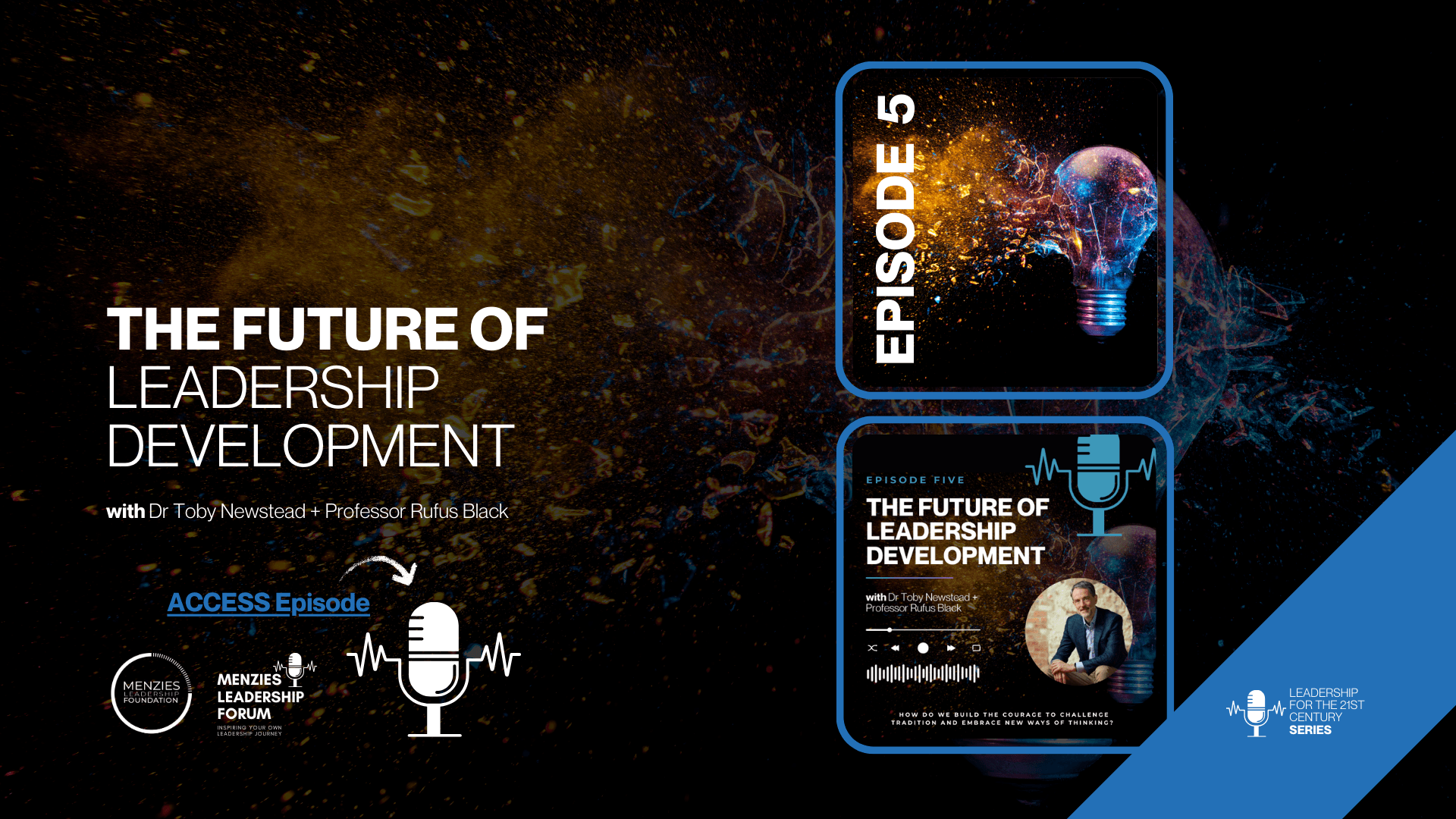
In the fifth episode of The Future of Leadership Development, host Dr Toby Newstead speaks with Professor Rufus Black, Vice-Chancellor of the University of Tasmania and one of Australia’s most thoughtful voices on institutional transformation. Their dialogue explores what it means to lead deep transitions — and how to sustain the moral courage such work requires.
The Long Arc of Transformation
Black begins with a provocation: “Transformation is not an event. It’s a continuous process of renewal.” Real change, he argues, is less about disruption than about capacity building — the ongoing cultivation of systems that can learn, adapt, and regenerate.
He likens effective leadership to tending a garden: you can’t force growth; you can only cultivate conditions. The image captures a deeper truth — that leadership is an act of stewardship rather than ownership. It’s about nurturing possibility across time rather than imposing direction in the moment.
For Black, this demands an expanded sense of time. “We’re trapped by the tyranny of the immediate,” he observes. “To lead transformation, you have to work for the long now.” The task is not to deliver quick wins but to lay foundations strong enough to hold future generations.
Truth, Trust and Transparency
At the heart of Black’s philosophy is moral clarity. “Trust is the ultimate currency of leadership,” he says. “And trust grows through truth.” In times of uncertainty, the instinct is often to project certainty — to reassure. Yet Black insists that candour is the real source of strength.
Complexity thrives on honesty. When leaders are transparent about uncertainty, they invite others into problem-solving rather than performing invincibility. Truth-telling becomes a collective act — an acknowledgement that no single person holds the whole picture. As Black puts it, “The moment you pretend you know more than you do, you break the trust that holds people together.”
Transparency, then, is not weakness but a form of distributed courage — the willingness to speak plainly about what is hard, unclear, or incomplete.
Institutions as Living Systems
The conversation turns to how institutions themselves can embody this mindset. Black’s work at the University of Tasmania provides a living example. The university’s shift toward more community-anchored, place-based models — “becoming smaller in structure but larger in impact” — represents a deliberate move from hierarchy to interdependence.
For him, institutions are not machines to be managed but organisms to be cultivated. Their health depends on diversity, feedback, and connection. “You lead transitions one conversation at a time,” he says. This incrementalism is not cautiousness but craft: the slow, disciplined process of aligning structures with values.
Such transitions ask leaders to navigate between legacy and possibility — to honour the past while building for futures that don’t yet exist. It is demanding work that requires both conviction and compassion.
The Inner Discipline of Purpose
Black insists that the sustainability of leadership begins within. “If leaders aren’t grounded in purpose,” he warns, “they’ll be blown around by every gust of change.” Purpose, in his view, is not a slogan but a stabilising force — the compass that allows courage to be consistent rather than reactive.
He speaks of purpose as a discipline — something to be returned to daily, like breath. It guides judgement when data runs out and replenishes courage when fatigue sets in. In profound transitions, purpose becomes both anchor and fuel.
Collective reflection also matters. Leadership, Black says, “isn’t about carrying the burden alone; it’s about distributing meaning so others can carry it too.” When shared purpose is made explicit, it transforms isolation into solidarity and stress into stewardship.
Building Capacity for Change
If transformation is continuous, then leadership development must build endurance. “We spend too much time preparing people to manage stability,” Black observes. “We need to build capacity to live inside change.”
This capacity is psychological as much as strategic. It involves resilience, empathy, and systems awareness — qualities that enable leaders to stay open rather than defensive in the face of disruption. It also requires re-imagining power: moving from control to connection, from performance to partnership.
Black’s insight reframes leadership education: it is not about mastering techniques but about expanding inner space — the ability to hold complexity without collapse. Development becomes the practice of enlarging one’s capacity for reflection, compassion, and moral imagination.
The Virtue of Patience
Among the most counter-cultural of Black’s ideas is his insistence on patience as a leadership virtue. In a world optimised for speed, patience is often mistaken for inertia. Yet the capacity to wait, to allow ideas and relationships to mature, may be the most radical act of all.
“Change worth having takes time,” he reminds us. Patience is not passive; it’s active attentiveness — the willingness to stay engaged through ambiguity. In this light, patience becomes strategic, even ethical. It protects integrity in systems tempted to shortcut complexity.
To practise patience is to reject the illusion of instant transformation and embrace leadership as a long apprenticeship in service of the common good.
Temporal Courage and the Greater Good
Ultimately, Black’s argument is that leadership in transition is about temporal courage — the ability to act now for outcomes we may never see. “We lead too much for the next quarter,” he laments. “We need to lead for the next generation.”
This re-centres leadership around legacy. The measure of success is not efficiency but endurance: will the values we embed today still serve when we are gone? For Black, this is both a moral question and a design challenge — how to build institutions and cultures that remain adaptive, humane, and purposeful long after their founders move on.
The future will belong to those who can hold this tension: to lead with urgency while thinking in decades; to stay humble while shaping systems that outlast them. It is a patient form of bravery — and one our time desperately needs.
🎧 Listen to Episode 5 — Leading Profound Transitions: Building Capacity for Change on The Future of Leadership Development, featuring Professor Rufus Black in conversation with Dr Toby Newstead.
At the Menzies Leadership Foundation, we see leadership today unfolding in a world of deep transition. Institutions are being reshaped, certainty is fleeting, and the pace of change is testing not just capability, but character. In this context, leadership is less about speed and control, and more about patience, purpose and moral courage.
Drawing on insights from Professor Rufus Black, The Patience of Change reframes leadership as stewardship. It calls leaders to build trust through truth, to cultivate conditions for learning and renewal, and to think beyond the immediate toward futures they may never see.
As change accelerates, patience becomes a leadership discipline. The future belongs to those willing to lead with humility, endurance and care for the greater good.