

Leadership does not begin with title or tenure. It begins when people choose to step forward, clarify their purpose, engage others and act for something larger than themselves.
A practical innovation space
The Menzies Leadership Foundation's Emerging Leaders platform continues to invest in that moment of transition, helping young Australians move from potential to practice through ethical capability, real-world opportunity and pathways for meaningful contribution.
Launched in 2021, the platform has been designed as a practical innovation space: testing how young people can best build the leadership capacity needed to navigate rising complexity and contribute to the greater good. Rather than focusing narrowly on individual achievement, the Foundation's approach centres distributed leadership, strengthening collaboration, systems awareness, civic responsibility and the confidence to lead with others.
Throughout 2025, this work continued through a growing network of partners including The Ethics Centre, Federation University, Global Voices, and emerging collaborations with Social Ventures Australia. Together, these partnerships are helping build a stronger national pipeline of purpose-driven leadership.
Fellowships on the world stage
A defining feature of the year was the continued partnership with Global Voices, enabling outstanding young Australians to engage directly with major international forums and policy conversations. Through the Menzies Fellowships, participants were supported to represent Australia globally while deepening their own sense of leadership purpose.
In 2025, Adjoa Assan was awarded the Menzies Fellowship to attend the Y20 Summit in South Africa, where young leaders contribute perspectives to the broader G20 agenda. Her work as a youth worker and lawyer in Western Sydney, combined with a strong commitment to social justice and representation, reflected the calibre of emerging leaders the Foundation seeks to support.
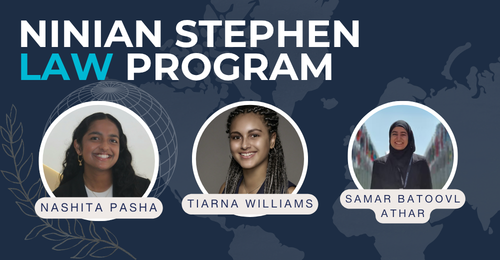
The Foundation also continued its support for the Sir Ninian Stephen Law Fellowships, enabling young Australians to engage with the United Nations General Assembly in New York. Fellows including Nashita Pasha, Tiarna Williams and Rayana Ajam published public policy commentary and contributed informed perspectives on issues including justice, family violence reform and human rights. Their reflections reinforced the transformative nature of international exposure in building leadership confidence, policy literacy and public voice.
These experiences are not symbolic. They are formative. They help young people translate ambition into contribution and conviction into action.
Ethics as leadership education
Alongside global exposure, the Foundation deepened its focus on ethical leadership through its partnership with The Ethics Centre. Across 2025, insights from this work increasingly demonstrated that ethics education supports better learning, better living and better leadership. Ethical reasoning is proving to be a high-potential vehicle for helping young people develop purpose, resilience and the ability to navigate difficult choices in an uncertain world.
This work continued through curriculum innovation, teacher engagement and research partnerships. A PhD project with Federation University progressed during the year, focused on strengthening ethical understanding through the Australian English curriculum. Additional research with the University of Queensland is exploring the relationship between personal ethical frameworks, wellbeing and resilience among young people.
Design Out Racism Challenge Prize
Another important milestone in 2025 was the continued development of the Design Out Racism Challenge Prize pilot. Delivered through school-based challenge formats, the initiative invites students to apply ethical reasoning, design thinking and systems thinking to one of the most pressing issues facing society.
Preliminary findings from the 2025 pilots were highly encouraging. The challenge prize model attracted strong school interest, with additional schools joining later rounds. Early evidence suggested students strengthened their skills in ethical leadership, collaboration and complex problem-solving, while schools valued a practical framework for engaging difficult social issues constructively.
The significance of this model extends beyond a single topic. It points to a scalable pathway through which schools, teachers and students can engage emerging challenges, including racism, technology disruption and artificial intelligence, through the lens of ethics and leadership.
Not waiting for permission
Across all of this work, a consistent theme emerged: emerging leaders are not waiting for permission. They are already stepping forward in schools, universities, communities and global forums. They are seeking purpose, building capability and taking responsibility in ways that challenge outdated assumptions about age and readiness.
The Foundation's role is to help accelerate that journey: to create pathways, expand horizons and ensure the next generation of leadership is equipped not only to succeed, but to serve.
Because the future will not be shaped by those who wait. It will be shaped by those prepared to lead before they are asked.
Potential to Practice
Leadership does not begin with title or tenure. It begins when people choose to step forward, clarify their purpose, engage others and act for something larger than themselves. In 2025, the Menzies Leadership Foundation’s Emerging Leaders platform continued to invest in that moment of transition — helping young Australians move from potential to practice through ethical capability, real-world opportunity and pathways for meaningful contribution.
Launched in 2021, the platform has been designed as a practical innovation space: testing how young people can best build the leadership capacity needed to navigate rising complexity and contribute to the greater good. Rather than focusing narrowly on individual achievement, the Foundation’s approach centres distributed leadership — strengthening collaboration, systems awareness, civic responsibility and the confidence to lead with others.
Throughout 2025, this work continued through a growing network of partners including The Ethics Centre, Federation University, Global Voices, and emerging collaborations with Social Ventures Australia. Together, these partnerships are helping build a stronger national pipeline of purpose-driven leadership.

A defining feature of the year was the continued partnership with Global Voices, enabling outstanding young Australians to engage directly with major international forums and policy conversations. Through the Menzies Fellowships, participants were supported to represent Australia globally while deepening their own sense of leadership purpose.

In 2025, Adjoa Assan was awarded the Menzies Fellowship to attend the Y20 Summit in South Africa, where young leaders contribute perspectives to the broader G20 agenda. Her work as a youth worker and lawyer in Western Sydney, combined with a strong commitment to social justice and representation, reflected the calibre of emerging leaders the Foundation seeks to support.
The Foundation also continued its support for the Sir Ninian Stephen Law Fellowships, enabling young Australians to engage with the United Nations General Assembly in New York. Fellows including Nashita Pasha, Tiarna Williams and Rayana Ajam published public policy commentary and contributed informed perspectives on issues including justice, family violence reform and human rights. Their reflections reinforced the transformative nature of international exposure in building leadership confidence, policy literacy and public voice.
These experiences are not symbolic. They are formative. They help young people translate ambition into contribution and conviction into action.

Alongside global exposure, the Foundation deepened its focus on ethical leadership through its partnership with The Ethics Centre. Across 2025, insights from this work increasingly demonstrated that ethics education supports better learning, better living and better leadership. Ethical reasoning is proving to be a high-potential vehicle for helping young people develop purpose, resilience and the ability to navigate difficult choices in an uncertain world.
This work continued through curriculum innovation, teacher engagement and research partnerships. A PhD project with Federation University progressed during the year, focused on strengthening ethical understanding through the Australian English curriculum. Additional research with the University of Queensland is exploring the relationship between personal ethical frameworks, wellbeing and resilience among young people.

Another important milestone in 2025 was the continued development of the Design Out Racism Challenge Prize pilot. Delivered through school-based challenge formats, the initiative invites students to apply ethical reasoning, design thinking and systems thinking to one of the most pressing issues facing society.
Preliminary findings from the 2025 pilots were highly encouraging. The challenge prize model attracted strong school interest, with additional schools joining later rounds. Early evidence suggested students strengthened their skills in ethical leadership, collaboration and complex problem-solving, while schools valued a practical framework for engaging difficult social issues constructively.
The significance of this model extends beyond a single topic. It points to a scalable pathway through which schools, teachers and students can engage emerging challenges — including racism, technology disruption and artificial intelligence — through the lens of ethics and leadership.
Across all of this work, a consistent theme emerged: emerging leaders are not waiting for permission. They are already stepping forward in schools, universities, communities and global forums. They are seeking purpose, building capability and taking responsibility in ways that challenge outdated assumptions about age and readiness.
The Foundation’s role is to help accelerate that journey: to create pathways, expand horizons and ensure the next generation of leadership is equipped not only to succeed, but to serve.
Because the future will not be shaped by those who wait. It will be shaped by those prepared to lead before they are asked.
Leadership does not begin with title or tenure. It begins when people choose to step forward, clarify their purpose and act for something larger than themselves. Through Menzies Fellowships at the Y20 Summit and the United Nations General Assembly, the Design Out Racism Challenge Prize, and deepening partnerships with The Ethics Centre, Federation University and Global Voices, the Foundation continued to help young Australians move from potential to practice — expanding what emerging leaders believe is possible, and what they feel equipped to do.
Emerging leaders are not waiting for permission. They are already stepping forward in schools, universities, communities and global forums — and if you believe the future will be shaped by those prepared to lead before they are asked, we invite you to stay connected with the Menzies Leadership Foundation and the work building the next generation of purpose-driven leadership in Australia and beyond.
Emerging leaders are not waiting for permission. They are already stepping forward in schools, universities, communities and global forums, and if you believe the future will be shaped by those prepared to lead before they are asked, we invite you to stay connected with the Menzies Leadership Foundation and the work building the next generation of purpose-driven leadership in Australia and beyond.