Leading Through the Unknown: Thriving in the Age of Complexity
How do you lead when the path ahead no longer exists?
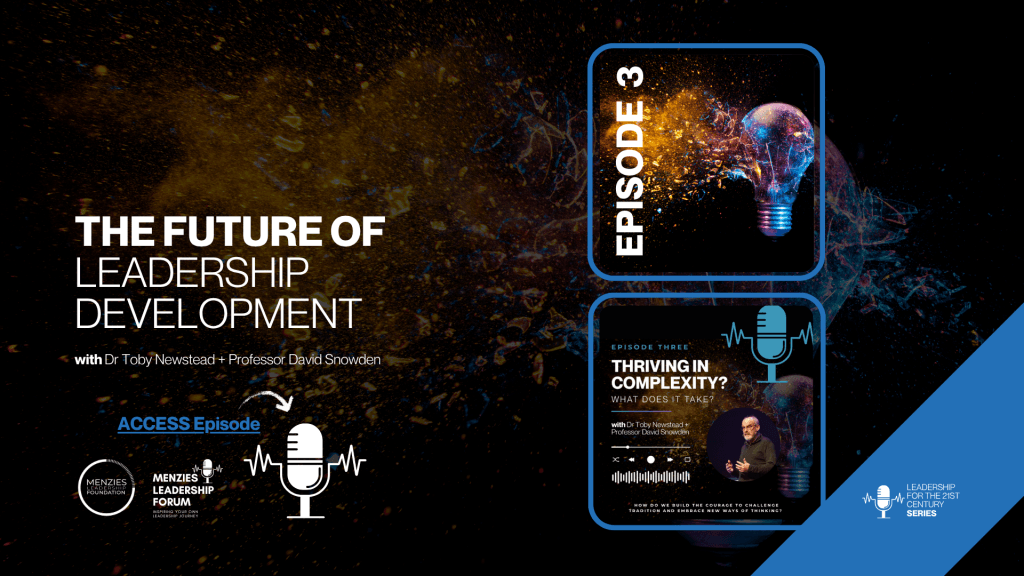
In an era where institutions, ecosystems, and communities are all reshaping themselves in real time, leadership has become less about direction and more about navigation. In the third episode of The Future of Leadership Development, host Dr Toby Newstead is joined by Professor David Snowden, founder of The Cynefin Company and creator of the Cynefin Framework, to unpack how leaders can make sense — and make progress — in a world defined by uncertainty.
When Maps Fail
Snowden’s work has become a cornerstone of modern complexity thinking. He draws a clear distinction between the complicated and the complex. Complicated systems, he explains, are like engines — predictable with enough analysis. Complex systems, by contrast, are alive. “You can only understand them retrospectively,” he says. “You can’t plan your way forward; you have to probe, sense, and respond.”
This shift in logic changes everything about leadership. The leader ceases to be a master planner and becomes an experimenter-in-chief. Progress depends not on the ability to forecast but on the courage to explore — to run safe-to-fail experiments and learn fast from their outcomes.
Snowden argues that our addiction to linear planning is a cultural hangover from industrial-era management. “The real world isn’t ordered,” he warns. “The belief that it is makes us fragile.” In complexity, control is replaced by curiosity.
Creating Context, Not Control
If control is an illusion, what remains of leadership? For Snowden, the answer is context creation. “The leader’s job is not to make decisions for people,” he says. “It’s to create the scaffolding within which good decisions can emerge.”
This means designing boundaries that guide without constraining — systems of feedback, narrative, and shared values that keep collective energy aligned even when outcomes are unpredictable. It also means decentralising authority so that local actors can adapt in real time. “You don’t get resilience from centralisation,” Snowden insists. “You get fragility.”
Effective leaders, then, are gardeners, not engineers. They shape the conditions for coherence, not compliance. Their power lies in attention: noticing what the system is trying to tell them before it speaks in crisis.
The Discipline of Sense-Making
Snowden defines leadership as “the art of sense-making under pressure.” It is a collective process — a way of continuously constructing meaning through dialogue, observation, and iteration. This demands humility: leaders must be willing to admit they don’t know. “If you think you understand a complex system,” he cautions, “you don’t.”
Instead of pretending to predict the future, sense-making leaders become explorers of the present. They run parallel experiments, look for emergent patterns, and adjust course quickly. The focus shifts from what’s the plan? to what are we learning? Complexity punishes certainty but rewards attentiveness.
Snowden’s Cynefin Framework provides one of the few practical guides for this mindset — distinguishing between clear, complicated, complex, and chaotic domains, each requiring a different form of leadership. Its genius lies in its simplicity: not every problem is the same kind of problem, and leaders must discern which logic applies before acting.
Ethics in the Unknown
In a world of unpredictable consequences, ethics becomes both harder and more essential. Snowden notes that in complexity, “you can’t know the full outcomes of your decisions — so ethics becomes about disposition.” Leadership, therefore, is not just about making the right call; it’s about how we make it — with care, curiosity, and consciousness of potential harm.
He argues that leaders should be judged less by outcomes and more by their ethical posture — whether they act with integrity when clarity is impossible. This shift reframes ethics from compliance to character. It is about cultivating the capacity to stay kind, fair, and alert amid ambiguity.
Learning in Action
Snowden is unsparing in his critique of conventional leadership programs. “You don’t learn to swim by reading a manual,” he says. Theory without context, he warns, breeds arrogance. Real learning must happen in the field — through practice, failure, and reflection.
He advocates for micro-learning: short, iterative cycles of experience and feedback embedded in real work. This model treats leadership development as an ongoing apprenticeship in awareness. “Complexity,” he reminds us, “is a teacher that never stops talking. The question is whether we’re listening.”
For Newstead, this conversation strikes at the heart of leadership education itself: if complexity is the context, then development must become continuous, contextual, and collective — not a program, but a practice.
The Power of Diversity
Complexity rewards diversity because diverse systems are more adaptable. Snowden sees consensus as a warning sign. “If everyone agrees,” he quips, “you’re probably wrong.” Difference — of perspective, experience, or discipline — expands the system’s field of awareness. The leader’s role is to curate variety, not suppress it.
This has profound implications for inclusion. When organisations truly value diversity as an asset rather than an obligation, they become more intelligent. Diverse teams see patterns earlier, test assumptions faster, and recover from shocks more effectively.
Leading in the Liminal
Snowden describes today’s leaders as “liminal actors” — those who operate in the threshold between stability and change. The liminal space is uncomfortable: the old logic has lost its grip, and the new one has yet to form. But that, he insists, is where transformation happens.
Leadership in the liminal is not about eliminating uncertainty but holding it long enough for coherence to emerge. It is about resisting the urge to retreat to false certainty. “In the past,” Snowden says, “we thought of leadership as creating order. Now it’s about enabling meaning.”
From Maps to Movement
Snowden closes with a simple truth: in complex systems, there are no maps — only landscapes that shift as we move through them. The work of leadership is to keep moving, guided by values rather than routes, and by curiosity rather than control.
This redefinition is not comfortable, but it is liberating. To lead in complexity is to trade the illusion of mastery for the discipline of learning — to move with the system, not against it. It is to see leadership not as a destination but as a journey undertaken together, step by adaptive step.
🎧 Listen to Episode 3 — Thriving in Complexity: Leading When There Are No Maps on The Future of Leadership Development, hosted by Dr Toby Newstead with Professor David Snowden.
At the Menzies Leadership Foundation, we know today’s leaders are operating in landscapes where clarity is brief and the path ahead is always shifting. Leadership is no longer about following the map — it’s about learning to move when no map exists.
Through the Menzies Leadership Forum, we’re exploring what it means to lead in complexity: to create context instead of control, to sense and respond rather than predict, and to empower people to act with curiosity, courage, and care.
By working with researchers, practitioners, and systems thinkers like Professor David Snowden, we aim to grow leadership as a shared human capacity — adaptive, ethical, and grounded in collective intelligence.
The age of certainty is over. The future of leadership begins with those willing to navigate the unknown together.