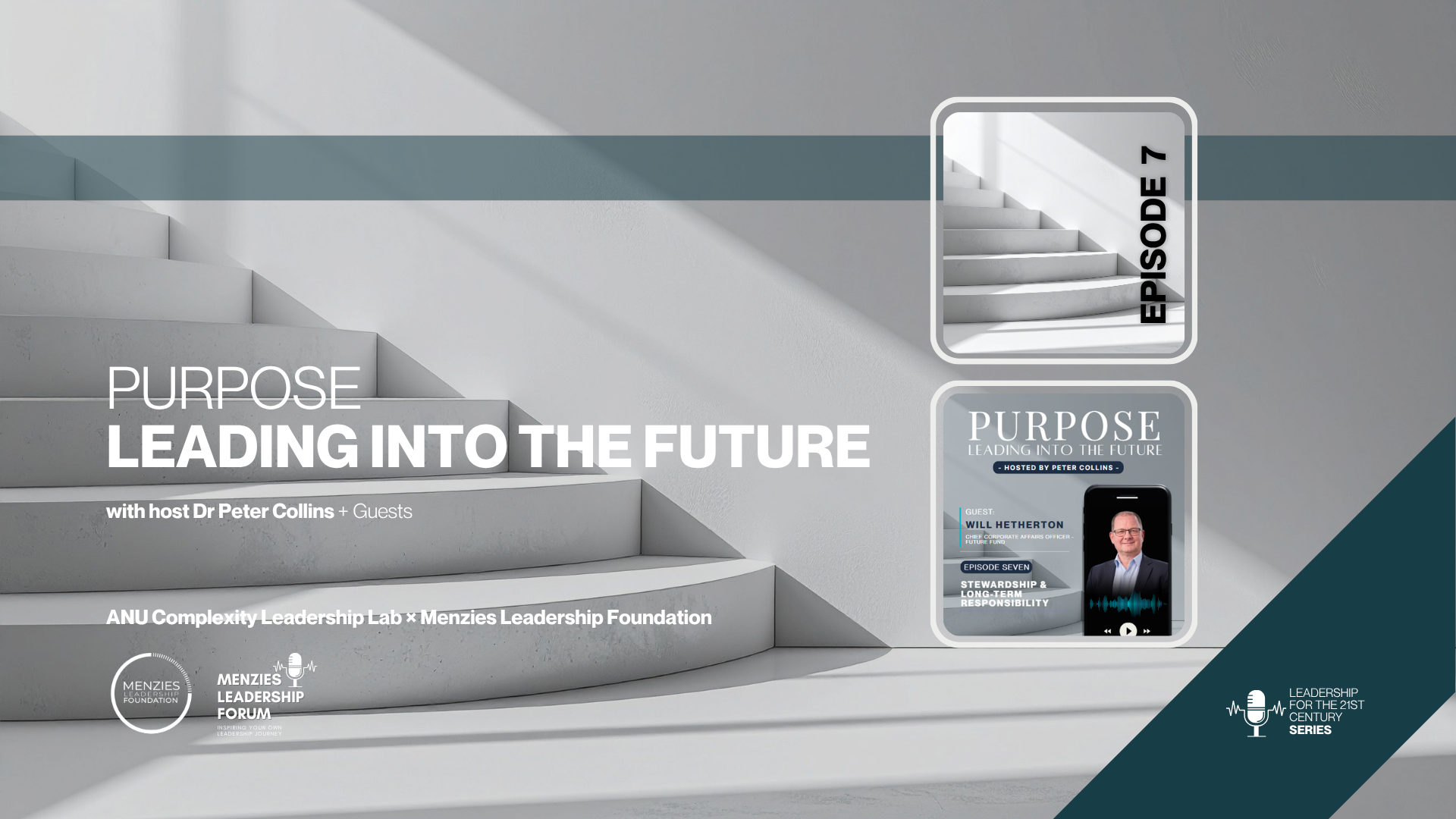
What does leadership require when responsibility stretches beyond quarterly cycles and across generations? In Episode 7 of Purpose: Leading into the Future, Will Heatherton — Chief Corporate Affairs Officer at Australia’s Future Fund — explores one of the most significant leadership questions of our time: How do institutions remain anchored in purpose when the decisions they make today are intended to shape the wellbeing of people decades into the future?
As the series deepens its examination of leadership as stewardship, this conversation moves into the realm of long-horizon institutional responsibility — where trust, judgement and discipline must be sustained over extended timeframes, often amid volatility and uncertainty. Because some institutions are not designed merely to perform in the present. They are designed to protect the future.
Purpose discovered over time
Reflecting on his own leadership journey — from the UK to Australia and into one of the nation’s most important financial institutions — Heatherton describes purpose not as something instantly known, but gradually realised. Early in his career, like many people, the focus was on progression, opportunity and building professional capability. But over time, something deeper emerged: the recognition that work could be connected to contribution.
Interestingly, Heatherton traces part of this orientation back to his upbringing in a Quaker school tradition — one shaped by ideas of stewardship, responsibility and social contribution. The legacy of Quaker-led organisations such as Cadbury and Rowntree is referenced not simply as history, but as an example of how purpose can be embedded into enterprise itself. This becomes an important framing for the entire conversation: leadership is not only about achieving outcomes, but about holding responsibility on behalf of others.
The Future Fund and intergenerational stewardship
The Future Fund was established in 2006 following Australia’s Intergenerational Report, which identified the long-term fiscal pressures associated with an ageing population. The institution’s task was ambitious: to take a national financial surplus and invest it in ways that would strengthen Australia’s long-term financial resilience.
Over two decades, the Fund has grown from approximately $60 billion to more than $270 billion — becoming the Commonwealth’s largest financial asset. But what makes the conversation compelling is not simply the scale of the capital; it is the philosophy behind it. The Future Fund is ultimately an exercise in intergenerational responsibility: saving and investing on behalf of people not yet present in today’s decision-making conversations. This reframes finance itself, turning investment into not only economic activity, but a form of national stewardship.
Purpose beyond the balance sheet
A defining insight throughout the episode is that purpose creates meaning beyond technical expertise. Many staff members at the Future Fund are deeply skilled financial professionals who could work almost anywhere, yet Heatherton explains that people are drawn to the institution because they feel connected to something larger than themselves.
This becomes especially visible through the other national funds the organisation manages, including:
- the Medical Research Future Fund
- Indigenous-focused investment initiatives
- drought and disaster resilience funds
- and social and affordable housing investment programs
One particularly powerful example involves an employee whose family member participated in medical treatment research funded indirectly through the organisation’s investment returns. In that moment, the connection between financial stewardship and human impact became tangible — purpose was no longer abstract, it became personal.
Culture shaped by shared responsibility
Heatherton repeatedly returns to the relationship between purpose and culture. The Future Fund deliberately cultivates diversity of thinking: different disciplines, different perspectives, different investment viewpoints, and different interpretations of emerging global risks.
But diversity alone is not enough. Without a shared purpose, organisations risk fragmentation. Purpose becomes the thread that binds together differing viewpoints around a common long-term objective, which is particularly important in environments where uncertainty is constant and no single person possesses all the answers.
Leadership under uncertainty
One of the most fascinating aspects of the episode is the Future Fund’s approach to investing itself. Rather than rigidly allocating assets into fixed categories, the organisation continuously reassesses geopolitical dynamics, demographic shifts, technological disruption, inflationary pressure, and changing market correlations.
This requires leaders and investment teams to constantly challenge assumptions — even when it means questioning their own areas of expertise. A property specialist, for example, may ultimately recommend investing elsewhere if long-term conditions no longer support the asset class. This demands a level of institutional maturity often difficult to sustain: placing the long-term mission above personal preference or professional identity.
Purpose as a stabilising force
A recurring theme across the series is that purpose matters most when conditions become uncertain, and this conversation reinforces that idea powerfully. The world described by Heatherton is one defined by geopolitical fragmentation, technological disruption, demographic transition, climate risk, and shifting social expectations.
In such environments, leadership requires more than technical competence. It requires a stable orientation — a “North Star” capable of guiding decision-making when external conditions fluctuate rapidly. Purpose provides that orientation.
Ethics, investment and contested expectations
The episode also confronts one of the most difficult realities facing modern institutions: stakeholder expectations are increasingly divergent. Questions surrounding fossil fuels, defence industries, climate transition, AI governance, and global supply chains rarely produce universal agreement.
Rather than attempting to satisfy every competing demand, the Future Fund uses a structured framework grounded in legislation, government mandates, international treaties, sanctions regimes, and long-term risk management principles. This does not eliminate disagreement, but it creates consistency, transparency and disciplined reasoning. Leadership, the conversation suggests, is not about avoiding complexity — it is about creating principled ways to navigate it.
Stewardship through influence
Importantly, the Future Fund recognises that institutions of scale possess influence beyond their direct investments. As a major global investor, the organisation participates in international discussions around responsible investment, AI governance, sustainability, workforce transformation, and long-term institutional resilience.
This broadens the meaning of stewardship. The role is not only to manage assets responsibly, but to contribute thoughtfully to shaping the systems in which those assets operate.
The long horizon of leadership
One of the most powerful ideas emerging from the episode is the discipline of maintaining long horizons in short-term environments. Modern institutions face enormous pressure from political cycles, media cycles, market volatility, and public expectation for immediate outcomes.
Yet stewardship often requires resisting short-termism, and this is where leadership maturity becomes critical. Stewardship, Heatherton argues implicitly, is not passive caution — it is the disciplined capacity to remain anchored to long-term purpose despite immediate noise and pressure.
AI, uncertainty and the future
Toward the conclusion of the conversation, the discussion turns toward artificial intelligence and technological transformation. Heatherton recognises AI as both an enormous investment opportunity and a profound societal challenge, with implications that extend across labour markets, gender equity, governance, public trust, and institutional decision-making itself.
Rather than framing technology as purely disruptive or purely optimistic, the conversation approaches it through the lens of stewardship: how do institutions navigate transformation responsibly while protecting long-term societal resilience?
What this means for leadership
This episode expands the series’ exploration of purpose into the realm of intergenerational responsibility. It asks how leaders hold purpose across decades, how institutions resist short-term pressure, and how organisations sustain trust when future consequences remain uncertain. The answer offered is subtle but powerful: leadership is stewardship exercised over time.
Looking ahead
As Purpose: Leading into the Future continues, this conversation highlights one of the defining challenges facing modern leadership: can institutions remain genuinely future-oriented in environments dominated by immediacy? Because increasingly, leadership is not judged solely by present performance.
It is judged by whether organisations protect future resilience, sustain public trust, act responsibly under uncertainty, and leave systems stronger for the generations that follow. And ultimately, whether they understand that stewardship is not about holding power for today but about holding responsibility for tomorrow.