

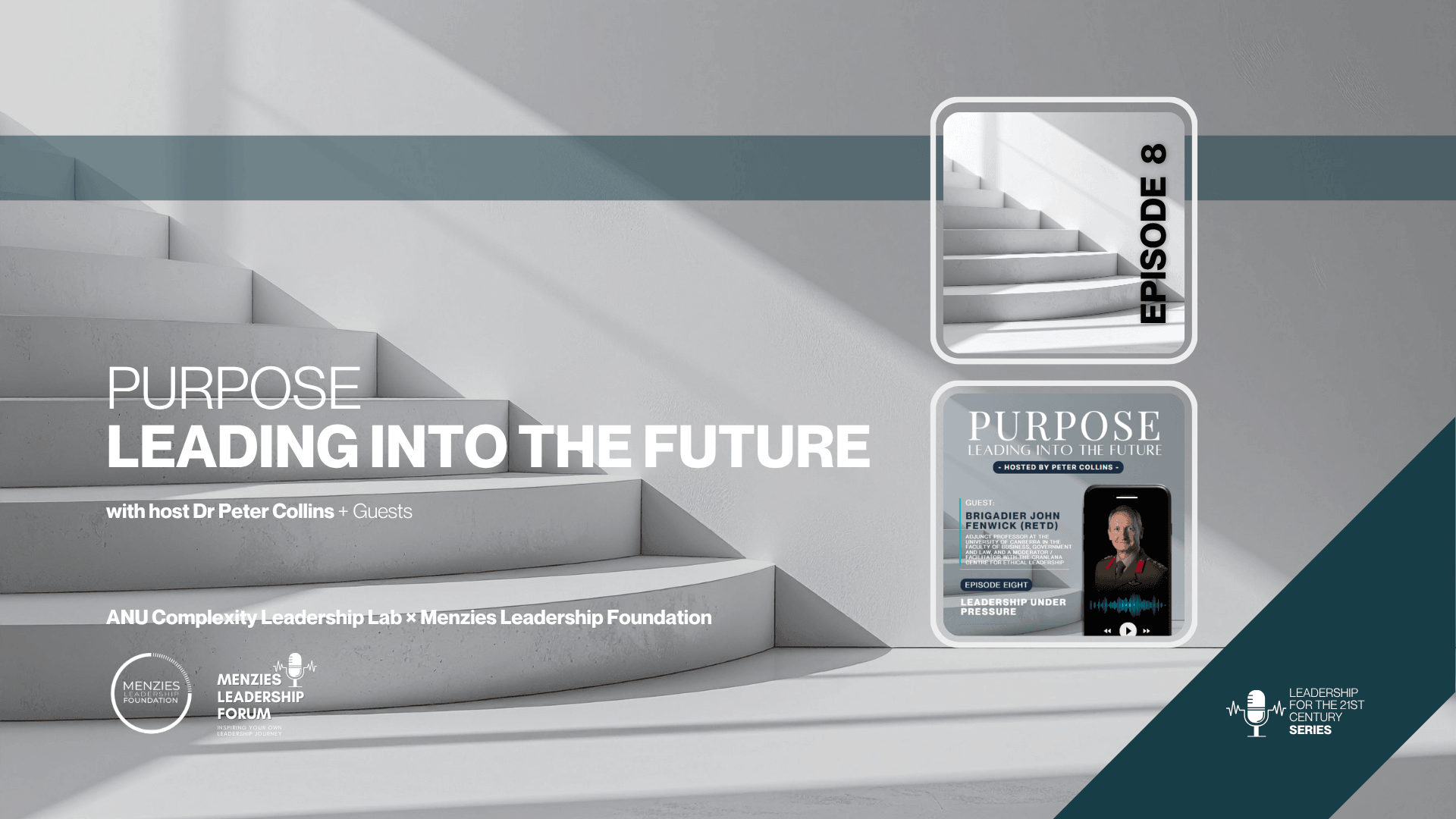
What kind of leadership does the next chapter demand? In the final episode of Purpose: Leading into the Future, Brigadier John Fenwick (Retd) reflects on leadership in some of the most demanding environments imaginable — where uncertainty is constant, consequences are profound, and decisions carry moral weight far beyond immediate outcomes.
Drawing on decades of military leadership, international operations and ethical leadership education, the conversation explores a defining challenge for contemporary leadership: how do leaders remain anchored in purpose when pressure intensifies, stakes escalate and certainty disappears? As the concluding episode of the series, the discussion returns to one of its central themes: leadership is not simply performance — it is guardianship exercised under pressure.
Purpose as a moral compass
From the outset, Fenwick describes purpose not as a slogan or aspirational statement, but as something closer to a compass — a "North Star" that shapes judgement before, during and after action. Importantly, purpose is not only useful in moments of planning; it becomes critical when leaders are forced to reconcile difficult decisions with their own conscience afterward.
This introduces one of the episode's most powerful concepts: moral injury. Fenwick defines moral injury as the internal struggle that occurs when actions, decisions or circumstances conflict with deeply held values. But he also introduces a second, less discussed possibility: moral discovery. Sometimes difficult ethical situations, rather than diminishing a person's moral clarity, deepen and strengthen it. This distinction becomes central to the conversation: leadership under pressure is not only about surviving complexity — but potentially growing through it.
The difference between ethics and integrity
One of the most compelling insights in the episode is Fenwick's distinction between a test of ethics and a test of integrity. A test of ethics occurs when leaders genuinely do not know the right course of action — the dilemma itself is uncertain. A test of integrity, however, is different: leaders know the right thing to do, but acting on it carries difficulty, consequence or personal cost.
This distinction matters enormously in modern leadership environments, because increasingly, leaders are not only navigating ambiguity. They are also navigating pressure — institutional, political, operational, reputational and human. Purpose, therefore, becomes not simply an organisational ideal, but a stabilising mechanism that helps leaders hold direction when external forces intensify.
East Timor and the challenge of reconciliation
Fenwick reflects deeply on his experience as a United Nations military observer in East Timor following the violence surrounding independence. Part of his role involved helping communities reintegrate former militia members back into village life — including individuals connected to violence and atrocities. The ethical challenge was profound: how do you reconcile personal moral discomfort with a broader mission of national reconciliation?
The answer, Fenwick explains, came through clarity of purpose. The leadership intent of East Timorese leaders was not retribution, but long-term reconciliation and social rebuilding, and purpose became the lens through which difficult decisions could be understood and sustained. This highlights a critical leadership insight: sometimes leaders must operate beyond personal emotion in service of broader societal healing.
When legality is not enough
The conversation also explores Fenwick's experience in Iraq as Deputy Commanding General supporting coalition operations against ISIS. In that role, he carried significant authority — including responsibility for targeting decisions. Importantly, Fenwick describes occasions where both coalition and legal advisors confirmed that an action was legally permissible, yet he still chose not to proceed.
Why? Because legality alone did not resolve the ethical question. This is one of the most significant themes of the entire series: leadership requires judgement beyond compliance. The law may define what leaders can do — purpose and ethics help determine what leaders should do.
Ethics as a disciplined practice
A recurring idea throughout the episode is that ethical leadership cannot be improvised in moments of crisis. Fenwick strongly rejects the notion that leaders can simply "pull ethics out of the kit bag" when pressure emerges. Instead, ethical judgement must be cultivated over time through reflection, education, practice, discussion and habit formation.
This reflects a deeply Aristotelian view of leadership: character is developed through repeated practice and disciplined behaviour. Fenwick credits much of his own development to the Australian Defence Force's investment in character and ethical leadership programs, including his participation in the Cranlana Centre for Ethical Leadership's ethics colloquium. The implication is clear: ethical capability is not accidental — it must be intentionally developed.
Shared values across difference
Another significant insight emerges through Fenwick's reflections on coalition leadership. While serving alongside more than 70 nations in Iraq, he was required to help sustain operational cohesion despite vastly different cultures, priorities, rules of engagement, and political objectives.
His approach was not to focus first on difference — it was to identify shared values. This is a powerful lesson far beyond military contexts, since modern organisations increasingly operate across ideological difference, political polarisation, cultural diversity, and competing stakeholder expectations. Leadership, therefore, becomes the capacity to build alignment without demanding uniformity.
AI, warfare and the erosion of restraint
The episode also explores one of the most urgent ethical questions facing modern institutions: the role of artificial intelligence in decision-making. Fenwick reflects on the dangers of what ethicists describe as "predictive permissibility" — situations where AI-generated predictions may be treated as certainty, potentially lowering the threshold for harmful or violent action.
Two major risks emerge: erosion of restraint and erosion of accountability. If leaders over-trust AI systems, they may act too aggressively, assume predictive certainty where none exists, or attempt to transfer responsibility for decisions onto technology itself. Fenwick argues that leaders must understand not only what AI systems recommend, but how they arrive at conclusions, what assumptions underpin them, and where uncertainty still exists. Again, the central question becomes not "What can we do?" but "What should we do?"
Leadership as guardianship
Perhaps the defining contribution of the episode is its framing of leadership as guardianship. Fenwick argues that leadership carries a moral obligation to hold authority with humility, with discipline, and on behalf of others.
This is particularly important in environments where institutional trust is declining, public legitimacy is fragile, and societal complexity is increasing. Leadership, in this sense, is not ownership of power — it is stewardship of responsibility.
Values must be lived
Toward the end of the conversation, Fenwick offers a direct warning for organisations attempting to articulate values without embodying them. Values that are merely displayed — but not lived consistently — become "worse than meaningless." They become corrosive.
This insight echoes across the entire podcast series. Purpose and values only become real when visible in behaviour, decisions, culture, incentives, and leadership conduct under pressure. Leadership credibility is built not through statements alone, but through consistency between words and action.
What this means for leadership
As the concluding episode of Purpose: Leading into the Future, this conversation brings the series' core themes into sharp focus. Leadership today increasingly demands moral clarity under uncertainty, disciplined judgement under pressure, stewardship over power, and the ability to sustain legitimacy when consequences are amplified.
The environments may differ — from boardrooms to battlefields — but the leadership challenge remains remarkably similar: how do leaders hold to purpose when pressure intensifies?
Looking ahead
Throughout this series, leaders from finance, industry, government, public institutions and national security have reflected on a common truth: leadership is ultimately an ethical practice. Not because leaders will always have clear answers, but because they are continually required to make decisions on behalf of others in conditions of uncertainty.
This final episode leaves us with an enduring challenge: in an age of complexity, volatility and accelerating technological change, can leaders still exercise disciplined restraint, moral judgement and genuine guardianship? Because increasingly, leadership will not be judged only by performance. It will be judged by trust, integrity, courage, responsibility, and whether leaders remain anchored to purpose when pressure is greatest. And ultimately, whether they remember that authority is never truly owned — only held in trust for others.
At the Menzies Leadership Foundation, we believe purpose can no longer remain aspirational — it must become operational. Brigadier John Fenwick's conversation is a rare and honest account of what that requires: not certainty, but disciplined judgement; not the letter of the law, but the harder question of what leaders should do. His story demonstrates something the series has returned to repeatedly: ethical leadership is not a reserve to draw on in a crisis. It is a capability built in advance, and it is what makes leadership under real pressure possible at all.
As institutions face rising complexity, faster technology and eroding public trust, those that treat character and judgement as something to be deliberately cultivated — not assumed — are the ones best placed to lead well when it matters most. Listen to Episode 8 of Purpose: Leading into the Future, explore the work of the Menzies Leadership Foundation, and consider how you can help cultivate the leadership our institutions most need.