
In theory, purpose is inspiring. In practice, it is demanding.
For The Hon. Justice Michael Kirby AC CMG, one of Australia’s longest-serving High Court Justices and a lifelong human rights advocate, purpose was never abstract. It was lived — case by case, judgment by judgment — often under intense scrutiny, and sometimes in dissent.
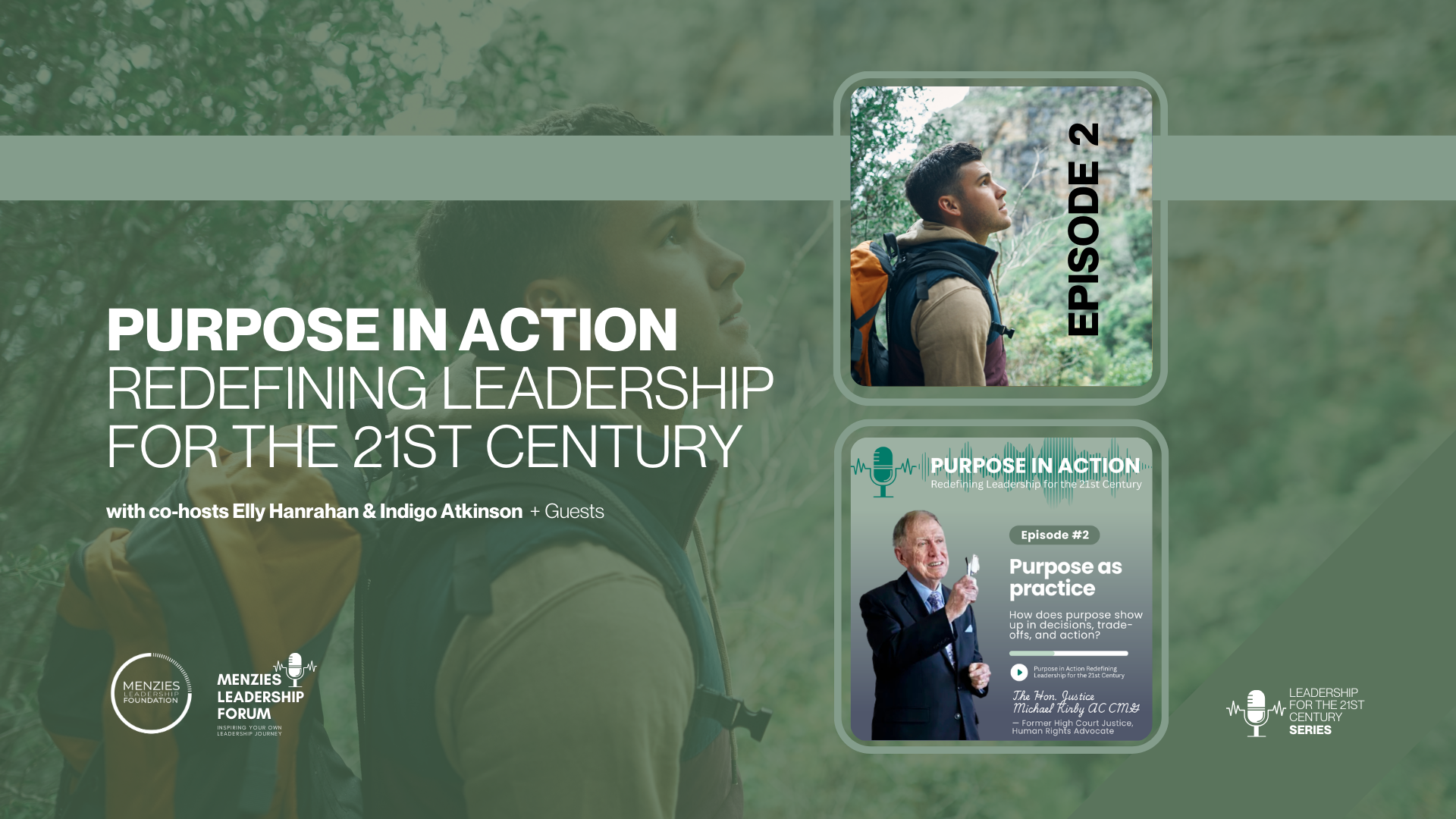
In Episode 2 of Purpose in Action, Justice Kirby reflects on what it means to live one’s values in high-stakes environments, where decisions are complex, disagreement is inevitable, and courage is required.
A childhood declaration — and a lifelong commitment
When asked in primary school what he intended to become, the young Michael Kirby replied: “Either a bishop or a judge.”
The answer, he jokes, may have reflected a fascination with “fancy dress.” But beneath the humour was something more enduring — a deep interest in order, authority, and the drama of intellectual conflict.
Yet the clarity of that childhood ambition did not immediately translate into a sophisticated understanding of justice. As he reflects, what first attracted him to the law was its promise of stability and order. The deeper awareness — that the law could both protect and perpetuate injustice — came later, shaped by lived experience and reflection.
This evolution is central to the episode’s theme: purpose is not only discovered; it is refined through practice.
Order and justice: a delicate balance
Throughout the conversation, Justice Kirby returns to a powerful dichotomy: law must reconcile order and justice.
Too much authority without justice, he argues, becomes authoritarianism. Too much justice without order risks chaos.
The task of a judge — and indeed any leader operating in complex systems — is to hold these tensions with integrity.
This balance became especially visible during his time on the High Court. Often labelled “the great dissenter,” Kirby resists the title. Dissents, he explains, are not acts of rebellion. They are expressions of duty.
In the Australian and English legal traditions, a judge has both the right and the obligation to express an honest view — even when it diverges from the majority. The health of the institution depends on that independence.
“It’s not really all that difficult,” he says. “Your duty is to give your honest opinion.”
Purpose, here, is not performative. It is procedural. It is the disciplined practice of stating what one believes to be true — respectfully, clearly, and without personal rancour.
His philosophy? “Kill them with kindness.”
The role of values in decision-making
When Justice Kirby entered law school in 1958, the dominant view — championed by Chief Justice Owen Dixon — was “complete and absolute legalism.” Judges, it was argued, did not create law; they merely declared what already existed. Values were irrelevant.
But Kirby studied under Professor Julius Stone, who challenged that orthodoxy. Judges, Stone argued, inevitably bring values to their decisions. The duty, therefore, is not to deny this reality — but to be transparent about it.
This intellectual debate shaped Kirby’s judicial philosophy. In moments of constitutional ambiguity or statutory uncertainty, he believed judges must explain not only their reasoning, but the values informing it.
That transparency, he suggests, strengthens democratic accountability. Citizens can support or critique a judgment not as mysticism, but as reasoned moral and legal argument.
Purpose, in this sense, becomes a disciplined practice of intellectual honesty.
Lived experience as moral compass
Kirby speaks candidly about how his upbringing influenced his values. Educated entirely in public schools, he encountered poverty, inequality and social marginalisation firsthand. His early awareness of his own sexuality — at a time when homosexuality was criminalised — sharpened his sensitivity to injustice embedded in law.
These experiences did not make him immune to doubt. But they shaped the lens through which he interpreted legal questions.
“Experience of feeling injustice,” he reflects, “can make you question things.”
For emerging leaders, this insight is profound: lived experience is not a liability in decision-making. It is a source of moral clarity — provided it is coupled with intellectual discipline.
International law: idealism or necessity?
A significant portion of the conversation explores Kirby’s longstanding commitment to international law and the United Nations.
In an era where multilateralism is contested and the authority of global institutions questioned, Kirby remains resolute. The United Nations, he acknowledges, is imperfect — particularly given the veto powers of the permanent five members of the Security Council. Yet its foundational achievement — the Universal Declaration of Human Rights — remains, in his view, one of humanity’s most important moral documents.
Article 1 declares: “All human beings are born free and equal in dignity and rights.”
For Kirby, that principle is not aspirational rhetoric. It is a standard against which domestic law should be measured.
He rejects the notion that international human rights norms are “heresy” within domestic legal reasoning. Instead, he sees reconciliation between domestic and international law as inevitable — and necessary — in an age of nuclear weapons, climate change, pandemics and mass migration.
Without shared principles, he warns, we risk sliding from a rules-based system into one governed by brute power.
Purpose, in this domain, becomes long-term stewardship — holding faith in institutions even when they are flawed, and working to strengthen rather than abandon them.
Advice to young leaders: be a joiner
As the episode closes, Justice Kirby offers practical counsel to young people seeking to lead with purpose.
Study the issues deeply.
Understand the history of institutions.
Keep the Universal Declaration of Human Rights close.
And above all: be a joiner.
Join organisations advancing human rights. Join groups defending minorities. Join movements opposing injustice. Participation, he suggests, is how purpose moves from sentiment to impact.
In a digital age often dominated by commentary, Kirby advocates contribution.
Don’t be disheartened
Despite the geopolitical turbulence of the past decade, Justice Kirby remains cautiously hopeful.
“The lesson of a long life,” he says, “is that things generally tend to come out good in the end — but only if the great majority of us contribute.”
Purpose, then, is not a grand gesture. It is a sustained practice.
It is the willingness to disagree respectfully.
To explain your values clearly.
To defend institutions while seeking to reform them.
To choose justice without abandoning order.
In a time when public discourse is increasingly polarised, Justice Kirby reminds us that leadership is not about volume or dominance. It is about integrity — lived consistently, even when inconvenient.
And that, perhaps, is purpose as practice.
_____________________________________________________________________________________________
🎧 Listen to Episode 2 — Purpose as practice on Purpose in Action Podcast Series.
____________________________________________________________________________________