In a world shaped by fragmentation, inequality and accelerating change, many leaders find themselves asking a deceptively simple question: What am I actually here to do?
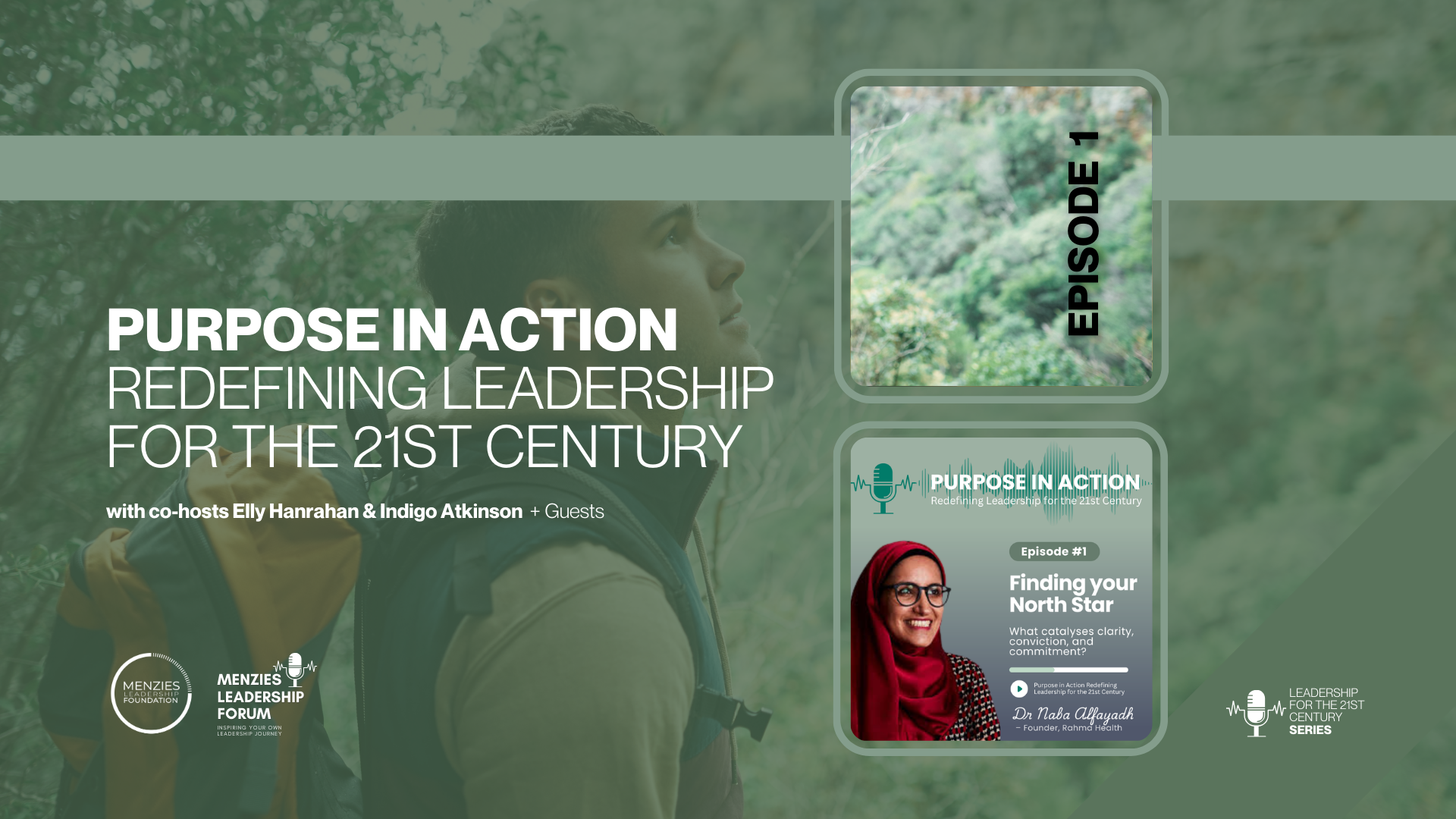
For Dr Naba Alfayadh, founder of Rahma Health and a globally recognised leader in health equity, that question has been guiding her life since her teenage years. In Episode 1 of the Purpose in Action podcast series, Dr Alfayadh reflects on what it truly means to find — and live by — a North Star, and why purpose is less about clarity in advance than commitment in motion.
Purpose as an energy source, not a destination
For Alfayadh, purpose is not a neatly defined end point. It is a sustaining force — the thing that generates energy for work, relationships and service, even when the path ahead is uncertain.
“Purpose is what gives me energy,” she reflects. “To have energy for anything — work, relationships, life — I need to be doing something values-aligned and purpose-driven.”
This understanding reframes purpose not as a static goal to be achieved, but as a living practice shaped through reflection, experience and action. Alfayadh describes years spent in deep self-inquiry — leadership retreats, journalling, poetry and reflection — not to perfect her purpose, but to remain in honest relationship with it. What has remained constant is a value that sits at the centre of her leadership: an unwavering belief in equal human dignity.
A turning point at fifteen
While Alfayadh resists the idea of a single defining moment, she traces a profound shift back to her mid-teens. At fifteen, she realised that waiting for “adults” or institutions to fix the world was futile. No one had a master plan. Everyone was improvising.
“That’s when I realised it was up to us — normal people, people who feel like imposters — to rise up and do our honest best,” she says. “Humbly. Kindly. And knowing our work will sometimes be imperfect.”
That insight became catalytic. It led first to the creation of Happy Brain Education — an organisation supporting young people from refugee and low socioeconomic backgrounds — and later to Rahma Health, now reaching millions globally with culturally safe, evidence-based health resources.
Lived experience as leadership intelligence
Throughout the conversation, Alfayadh makes clear that her leadership has been shaped as much by lived experience as by formal training. Growing up with poverty, displacement and exclusion gave her an acute awareness of how arbitrary privilege can determine opportunity — and how much human potential is lost as a result.
At medical school, those disparities became impossible to ignore. Access to tutoring, networks and information — things often taken for granted — fundamentally shaped who could imagine certain futures for themselves. Happy Brain Education was born from that injustice, built on a simple but powerful idea: those with lived experience are often best placed to support the next generation.
The result has been transformative — not only for the students supported, but for the broader leadership ecosystem it helps create.
Leadership as a collective act
Despite her accolades, Alfayadh consistently resists leader-centric narratives. Success, she argues, is never individual. It is emergent — created through teams, trust and shared values.
“The team is the magic,” she says. “They make the local revolution or the global revolution possible.”
At Rahma Health, values are not decorative. They are operational. The organisation is anchored in love, respect, joy and deep accountability to community — principles that guide decisions, partnerships and pace. That clarity has enabled the organisation to pursue systemic change while remaining grounded in relational practice.
Why love belongs in leadership
One of the most distinctive aspects of Alfayadh’s leadership philosophy is her insistence that love is not peripheral to serious work — it is central to it.
Working with families who have lived in survival mode for generations, Rahma Health focuses not only on information delivery but on healing — restoring safety, connection and the capacity for care. For Alfayadh, this work became deeply personal after becoming a mother herself.
Researching the role of attention, eye contact and emotional presence led to a surge of community engagement — and ultimately to what she describes as a “love revolution”: a body of work exploring healthy love, attunement and connection as foundations for wellbeing.
In policy, health and leadership contexts that often prioritise efficiency over humanity, Alfayadh’s work offers a quiet but radical reminder: what seems basic is often what is most transformative.
Burnout, boundaries and staying the course
Purpose-driven leadership is not without cost. Alfayadh speaks candidly about burnout — particularly during her time leading Happy Brain Education — and the difficulty of setting boundaries when the mission feels urgent and moral.
Her approach today is shaped by hard-earned insight: learning to recognise the early signs of exhaustion, prioritising rest and connection, and leaning into vulnerability rather than withdrawing from it.
“When it’s hard,” she says, “I lean in more. I tell my team what I’m experiencing — and every time, they rise to support me.”
Purpose, in this sense, is sustained not by heroic endurance, but by trust, humility and shared responsibility.
The thread that binds great leaders
Asked what she sees as the defining quality of leaders she admires, Alfayadh does not hesitate: humility.
Humility that creates space for others to shine. Humility that recognises leadership as relational rather than hierarchical. Humility that treats every person — regardless of role or status — with equal dignity.
In an era that often rewards visibility over values, her answer lands as both grounding and hopeful.
Purpose as a lifelong practice
The Purpose in Action series explores leadership not as performance, but as an ongoing inner journey — shaped by identity, experience and values, and tested in the real world .
Dr Naba Alfayadh’s story reminds us that finding your North Star does not require certainty. It requires courage, reflection, and a willingness to act — imperfectly — in service of something greater than yourself.
Purpose, as she shows, is not something you arrive at. It is something you choose, again and again.
 Listen to Episode 1 — Finding your North Star on Purpose in Action Podcast Series.