How do we find the courage to challenge tradition — and reimagine leadership for a world defined by complexity, interconnection, and constant change?
Leadership, as many of us learned it, was built for another era — an age of certainty, linear progress, and hierarchical control. It was a model that centred the heroic individual: the visionary at the top with the plan, the answers, and the authority. For much of the 20th century, that paradigm worked.
But that world no longer exists.
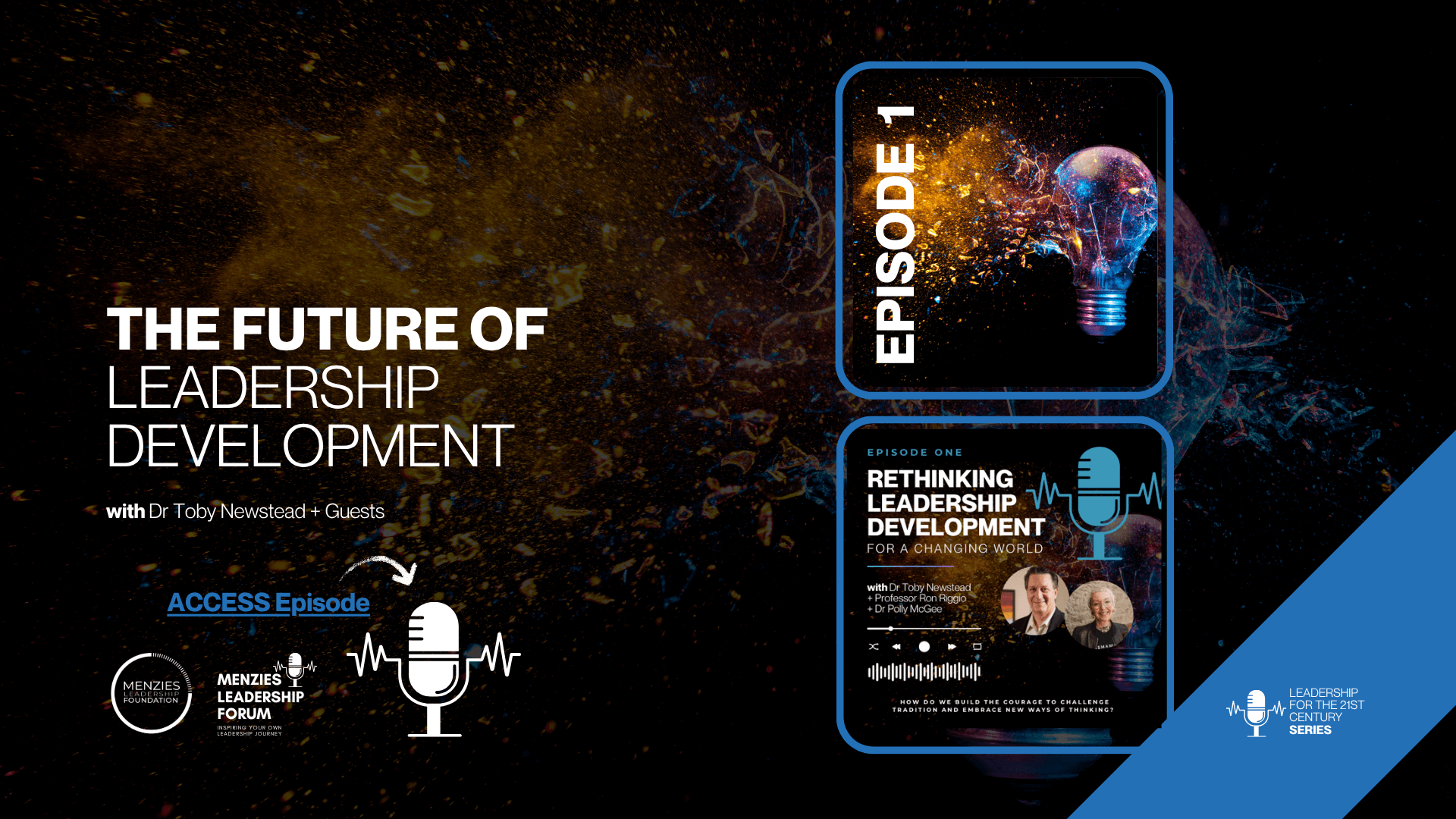
In the opening episode of the Menzies Leadership Forum’s new podcast series, The Future of Leadership Development, host Dr Toby Newstead is joined by two of the most forward-thinking voices in the field — Professor Ron Reggio, a global authority on leadership research, and Dr Polly McGee, a practitioner at the cutting edge of trauma-responsive leadership and human-centred systems change. Together, they argue that the leadership models we inherited are failing us — and that developing leaders fit for today’s world will require nothing short of a paradigm shift.
Beyond the Hero: Leadership as a Human System
At the heart of this shift is a simple but profound idea: leadership is not an individual trait — it is a collective capacity. “Leadership is co-created by leaders and followers working together in a specific context,” Reggio explains. “Each of us both leads and follows depending on the situation.” This challenges the long-held belief that leadership lives only at the top and repositions it as something distributed, relational, and shared.
It also demands that we see people as they truly are: complex, biological beings, not machines. McGee warns that too many organisations still “cast humans in the role of machines — expected to work endlessly, be replaced when broken, and perform in predictable ways.” But humans are not scalable components. We are organisms driven by deep evolutionary needs for safety, belonging, and reward. These instincts shape how we respond to uncertainty, authority, and change.”
When those needs are threatened, our nervous systems default to survival mode. “Our system looks for the most powerful mammal for support,” McGee notes. “We line up behind them — even when we don’t agree — because it feels safe.” It’s why societies often revert to simplistic narratives and authoritarian figures in times of crisis: biology, not logic, is in the driver’s seat. If leadership development fails to account for this, even the best-designed programs will crumble under pressure.
Leadership as a Flow, Not a Role
Recognising leadership as a human, collective phenomenon transforms how we think about leaders themselves. Their job is no longer to control outcomes or hold all the answers, but to curate the conditions under which people and ideas can thrive. Leadership becomes a flow — a dynamic rhythm in which influence shifts naturally between people depending on expertise, context, and need.
McGee describes the most effective leaders as “sweeping the ice” — clearing barriers so innovation and collaboration can move freely. That requires not just authority but attunement: the ability to sense when to step forward and when to step back. And it requires humility — an understanding that leadership does not begin and end with them.
This perspective also reimagines followership. Reggio argues that the field has historically failed to “engage followers or help them understand what exemplary followership looks like.” But every individual has the capacity — and the responsibility — to lead from where they are. He shares the example of a CEO who invited every employee, from senior executives to the front-desk receptionist, into leadership development programs. “The receptionist redesigned how visitors were greeted, creating a warmer, more consistent experience,” he recalls. “That’s leadership — and it didn’t require a title.”
From Titles to Capability
If leadership is everywhere, then leadership development must be everywhere too. Too often, organisations pour their resources into developing individuals with formal authority. But building the leadership we need requires us to develop capability, not just titles.
That means nurturing emotional intelligence, empathy, self-awareness, and relational skills across entire systems. It means creating conditions for those who don’t see themselves as leaders to step into influence. And it means embracing experimentation and failure as essential to learning. “Until we make space for trying things out and getting them wrong,” McGee warns, “we’ll keep defaulting to what feels safe — and perpetuate models that no longer serve us.”
It also requires a reimagining of leadership development itself. Too many programs, Reggio argues, are “like entertainment — an amusement park ride. It’s exciting while it lasts, but when it’s over, nothing changes.” True development is more like a gym membership: it requires time, effort, reflection, and consistent practice. And it requires motivation — a personal commitment to becoming one’s best self in service of the collective.
The Relational Future of Leadership
Strip everything else away, and leadership is — and always has been — about relationships. It is about how we connect with each other, make sense of complexity together, and move forward towards shared goals. As automation and AI reshape work, those human relationships will become even more central. “Once technology takes over everything else,” McGee observes, “all we’ll have left is each other.”
This is where the future of leadership development lies: not in producing more heroic individuals, but in expanding our collective capacity to lead and follow well. It lies in building cultures grounded in safety, belonging, and trust. It lies in reimagining organisations as living systems rather than machines. And it lies in recognising that leadership is not the preserve of the few — it is the work of us all.
The age of the solitary hero is over. The future belongs to the collective.
🎙️ Listen to Episode 1 of the Menzies Leadership Forum’s podcast series, The Future of Leadership Development — “Rethinking Leadership for a Changing World” — hosted by Dr Toby Newstead with Professor Ron Reggio and Dr Polly McGee — now streaming on all major podcast platforms.
At the Menzies Leadership Foundation, we believe the future of leadership will not be built by individuals standing above the system, but by people learning to move with it.
Through the Menzies Leadership Forum, we’re exploring how leadership can evolve from control to connection — from command to collaboration — so it reflects the complex, interdependent world we live in.
By working with researchers, practitioners and partners across sectors, we aim to grow leadership as a shared human capacity: one that is responsive, relational and rooted in care.
The era of the solitary hero is ending. The future of leadership begins with us — together.