
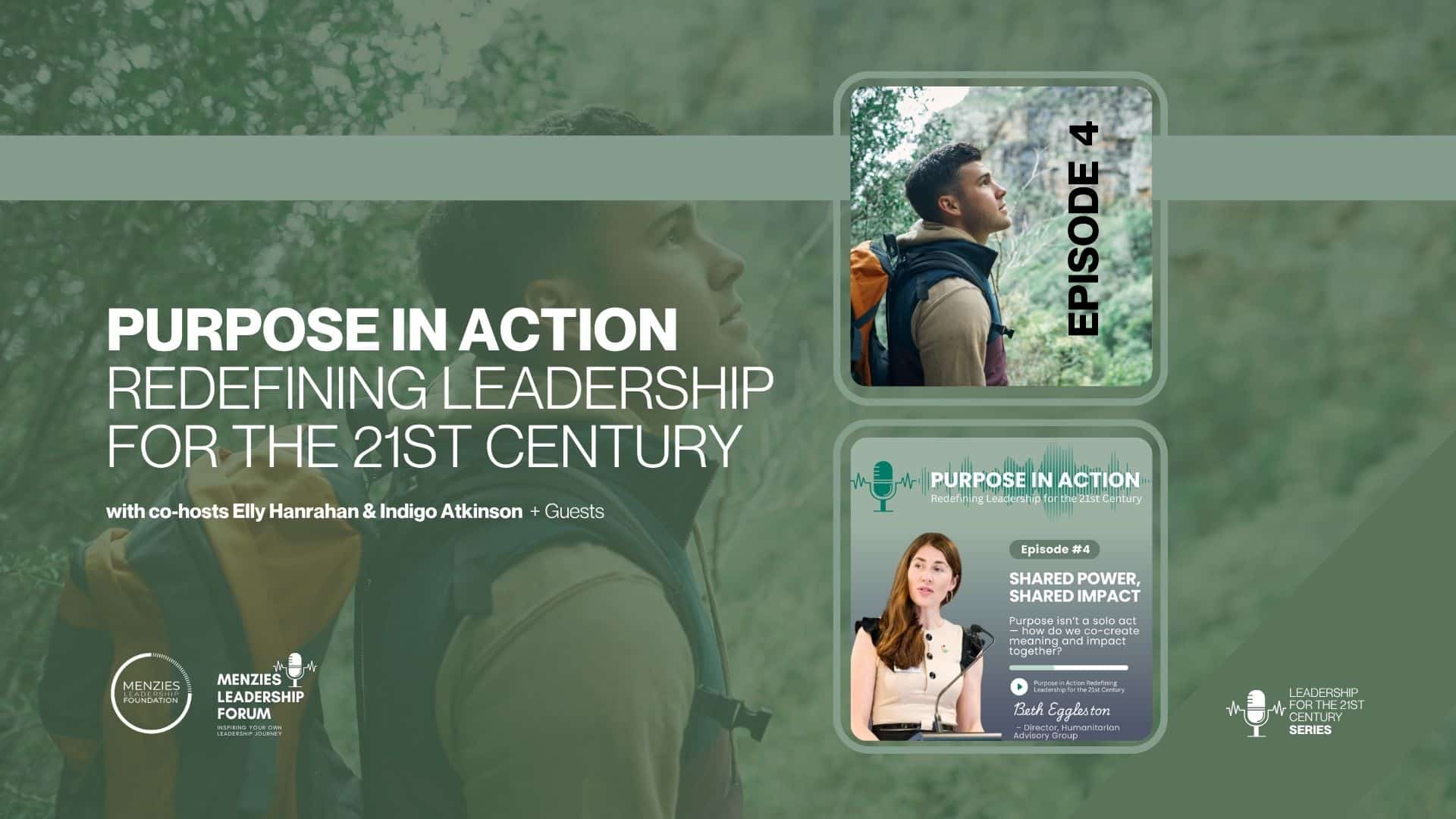
Purpose isn’t a solo act — how do we co-create meaning and impact together?
There is a persistent myth in leadership — that impact is driven by individuals.
That change is the result of singular vision, authority, or control.
But in complex, high-stakes environments, the opposite is true.
Impact is collective.
And leadership, at its most effective, is shared.
In Episode 4 of Purpose in Action: Redefining Leadership for the 21st Century, Beth Eggleston — Director at Humanitarian Advisory Group — brings this reality into sharp focus. Drawing on more than two decades of experience across global humanitarian contexts, she explores what it means to lead not from power, but through it — and, critically, how to share it.
Power sits at the centre of every system
In humanitarian work, power is not abstract — it is structural, embedded, and often unequal.
Crises do not create these dynamics.
They expose and amplify them.
“If we want to think about the root causes of humanitarian disasters… most of the time it is about the exacerbating of inequalities and underlying power structures that were there beforehand.”
From global institutions to local communities, decisions about resources, response, and recovery are shaped by who holds power — and who does not.
Yet despite decades of reform efforts, much of the system remains centralised.
Decisions are often made far from the communities they affect.
Knowledge flows unevenly.
And those closest to the problem are not always closest to the power.
From control to co-creation
Shifting this dynamic requires more than consultation.
It requires a fundamental rethinking of leadership itself.
Shared power is not about inclusion as a gesture.
It is about co-creation as a practice.
This means:
- Designing with, not for
- Listening beyond the usual voices
- Creating space for different forms of knowledge and experience
But this is not easy — particularly in high-pressure, time-critical environments.
Trust cannot be built in the moment of crisis.
It must exist beforehand.
“You can’t surge trust… you need to have relationships and trust before you’re going into a high-pressure situation.”
And meaningful engagement requires more than efficiency.
It requires time, intention, and a willingness to relinquish control.
The challenge of letting go
For many organisations, the greatest barrier to shared power is not capability — it is comfort.
Letting go of control challenges long-standing structures:
- Who leads
- Who decides
- Who is visible
Beth points to a critical shift: moving from extractive models of leadership — where organisations gather information and retain authority — to relational models, where leadership is distributed and evolves over time.
Partnership, in this context, is not static.
It is dynamic.
Roles change.
Leadership shifts.
Influence moves.
“It may have been the beginning that we were the lead… that is now totally flipped… they are leading on work.”
This is what shared power looks like in practice — not symbolic, but structural.
Visibility is power
One of the most tangible ways power is shared is through visibility.
Who speaks. Who is credited. Who represents the work.
Too often, local partners are positioned behind the scenes — gathering data, enabling delivery — while international organisations remain the public face.
Rebalancing this is critical.
“We want them to be the ones who go and talk about the research… the ones telling the story.”
Because influence follows visibility.
And visibility shapes whose knowledge is trusted, funded, and acted upon.
Leadership that lifts, not dominates
At the heart of shared power is a different kind of leadership mindset.
One that rejects the idea of leadership as a zero-sum game.
“If I’m taking a leadership role… it doesn’t mean that other people’s leadership is diminished.”
Instead, the most effective leaders:
- Elevate others
- Build networks of capability
- Strengthen collective intelligence
This is particularly evident in the way many women lead in complex systems — leaning into collaboration, amplification, and relational influence.
Leadership, in this sense, is not about holding power.
It is about enabling it.
A system under pressure — and an opportunity for change
The global humanitarian system is at a turning point.
Funding cuts, geopolitical shifts, and growing complexity are placing unprecedented strain on existing structures.
But within this disruption lies opportunity.
“You should never waste a crisis… there absolutely is an opportunity to fast track transformation.”
The question is whether the system will evolve — or entrench.
Whether power will be redistributed — or reinforced.
The future is shared
If purpose is to be realised at scale, it cannot sit with individuals or institutions alone.
It must be held collectively.
Practiced relationally.
And embedded systemically.
Shared power is not idealistic. It is necessary. Because in a world defined by complexity, no single actor holds the answer. But together — through trust, partnership, and a willingness to rethink leadership — something more powerful becomes possible:
Shared impact.
_________________________________________________________________________________________________
🎧 Listen to Episode 4 — Shared Power, Shared Impact on Purpose in Action Podcast Series.
_________________________________________________________________________________________________