Shared Power, Shared Impact

Purpose isn’t a solo act — how do we co-create meaning and impact together?

There is a persistent myth in leadership — that impact is driven by individuals.
That change is the result of singular vision, authority, or control.

But in complex, high-stakes environments, the opposite is true.

Impact is collective.
And leadership, at its most effective, is shared.

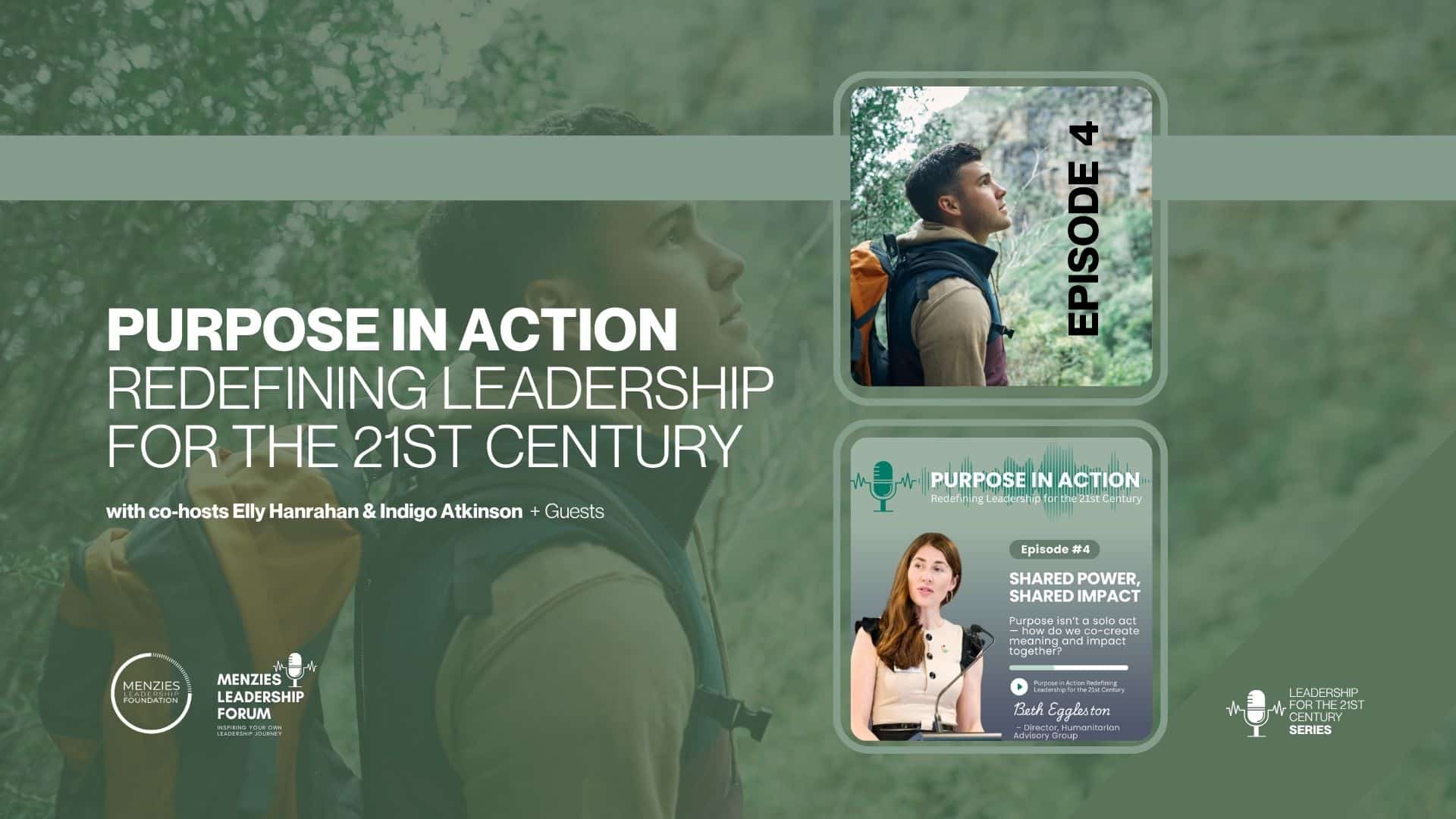
In Episode 4 of Purpose in Action: Redefining Leadership for the 21st Century, Beth Eggleston — Director at Humanitarian Advisory Group — brings this reality into sharp focus. Drawing on more than two decades of experience across global humanitarian contexts, she explores what it means to lead not from power, but through it — and, critically, how to share it.
Power sits at the centre of every system

In humanitarian work, power is not abstract — it is structural, embedded, and often unequal.

Crises do not create these dynamics.
They expose and amplify them.

“If we want to think about the root causes of humanitarian disasters… most of the time it is about the exacerbating of inequalities and underlying power structures that were there beforehand.”

From global institutions to local communities, decisions about resources, response, and recovery are shaped by who holds power — and who does not.

Yet despite decades of reform efforts, much of the system remains centralised.
Decisions are often made far from the communities they affect.
Knowledge flows unevenly.
And those closest to the problem are not always closest to the power.

From control to co-creation

Shifting this dynamic requires more than consultation.
It requires a fundamental rethinking of leadership itself.

Shared power is not about inclusion as a gesture.
It is about co-creation as a practice.

This means:

  • Designing with, not for
  • Listening beyond the usual voices
  • Creating space for different forms of knowledge and experience

But this is not easy — particularly in high-pressure, time-critical environments.

Trust cannot be built in the moment of crisis.
It must exist beforehand.

“You can’t surge trust… you need to have relationships and trust before you’re going into a high-pressure situation.”

And meaningful engagement requires more than efficiency.
It requires time, intention, and a willingness to relinquish control.

The challenge of letting go

For many organisations, the greatest barrier to shared power is not capability — it is comfort.

Letting go of control challenges long-standing structures:

  • Who leads
  • Who decides
  • Who is visible

Beth points to a critical shift: moving from extractive models of leadership — where organisations gather information and retain authority — to relational models, where leadership is distributed and evolves over time.

Partnership, in this context, is not static.
It is dynamic.

Roles change.
Leadership shifts.
Influence moves.

“It may have been the beginning that we were the lead… that is now totally flipped… they are leading on work.”

This is what shared power looks like in practice — not symbolic, but structural.

Visibility is power

One of the most tangible ways power is shared is through visibility.

Who speaks. Who is credited. Who represents the work.

Too often, local partners are positioned behind the scenes — gathering data, enabling delivery — while international organisations remain the public face.

Rebalancing this is critical.

“We want them to be the ones who go and talk about the research… the ones telling the story.”

Because influence follows visibility.
And visibility shapes whose knowledge is trusted, funded, and acted upon.

Leadership that lifts, not dominates

At the heart of shared power is a different kind of leadership mindset.

One that rejects the idea of leadership as a zero-sum game.

“If I’m taking a leadership role… it doesn’t mean that other people’s leadership is diminished.”

Instead, the most effective leaders:

  • Elevate others
  • Build networks of capability
  • Strengthen collective intelligence

This is particularly evident in the way many women lead in complex systems — leaning into collaboration, amplification, and relational influence.

Leadership, in this sense, is not about holding power.
It is about enabling it.

A system under pressure — and an opportunity for change

The global humanitarian system is at a turning point.

Funding cuts, geopolitical shifts, and growing complexity are placing unprecedented strain on existing structures.

But within this disruption lies opportunity.

“You should never waste a crisis… there absolutely is an opportunity to fast track transformation.”

The question is whether the system will evolve — or entrench.

Whether power will be redistributed — or reinforced.

The future is shared

If purpose is to be realised at scale, it cannot sit with individuals or institutions alone.

It must be held collectively.
Practiced relationally.
And embedded systemically.

Shared power is not idealistic. It is necessary. Because in a world defined by complexity, no single actor holds the answer. But together — through trust, partnership, and a willingness to rethink leadership — something more powerful becomes possible:

Shared impact.

_________________________________________________________________________________________________


🎧 Listen to Episode 4 — Shared Power, Shared Impact on Purpose in Action Podcast Series.

_________________________________________________________________________________________________

At the Menzies Leadership Foundation, we believe the future of leadership depends on who gets to hold it. Too many of our systems are shaped — whether by design or default — by the assumption that impact flows from individual authority, not collective action.

Beth Eggleston’s story is a challenge to that assumption. Drawing on more than two decades of experience across global humanitarian contexts, she makes the case that shared power is not a concession to collaboration — it is a condition of impact that actually lasts.

As crises continue to expose and amplify existing inequalities, leadership that lifts rather than dominates is not a soft ideal. It is the work.

Listen to Episode 4 of Purpose in Action: Redefining Leadership for the 21st Century. Engage with the Humanitarian Advisory Group. And if you believe that communities closest to the problem belong at the centre of the decisions that shape their future — help us build the conditions that make that possible.

Natasha Eskinja

Digital Communications Coordinator

Natasha is driven by a profound passion for both creativity and analytics, a synergy that fosters authentic storytelling in the digital realm with both innovation and integrity. 

Throughout her career, she has consistently integrated the overarching marketing and communications narrative with the emotional connections of audiences. She is currently pursuing a Certificate in Society and the Individual from Flinders University, furthering her exploration of human behaviour and the critical importance of connectedness between organisations, individuals, and communities.

LinkedIn | natasha.eskinja@menziesfoundation.org.au

Sarah Jenkins

Strategic Communications Manager

Sarah has more than 18 years’ experience in communications and marketing leadership across a range of sectors.

Communications strategy and organisational growth is a continuing theme in Sarah’s career. Most recently, she leads the development of a Leadership Movement, evaluated by Menzies Viral Co-efficient Model; a contribution to the NFP. 

Sarah’s early career centred around best practice in marketing and communications which later culminated into the establishment of her very own agency. This work extensively spanned across PR, traditional media, event management, strategy, digital marketing, graphic design and business development consultancy. 

In 2019, Sarah joined the lean and robust team at the Menzies Foundation. She has since crafted the Foundation’s narrative and communication strategy. The development of this strategic communications platform is essential for ‘movement building’ and requires a strong strategic, management and communication skills set. Sarah has brought so much to this important work, which sits at the forefront of communication practice. 

Sarah continues to contribute to the NFP sector through her commitment to Purpose; as she reflects on her own leadership, builds her own leadership capability and contributes to the greater good. 

LinkedIn | sarah.jenkins@menziesfoundation.org.au | 0401 880 071

Rohan Martyres

Director, Strategy and Partnerships

Rohan has 15 years’ experience in facilitating cross-sector collaborations to address complex social and health challenges.  He has worked with the World Economic Forum in Australia, led an international conflict resolution field team in Nepal, and directed a 10-year £40m initiative to reduce health inequity in London.

Most recently, Rohan was Major Grants Development Manager at the Ian Potter Foundation.  He refined the foundation’s major grants strategy, and co-developed a series of large scale initiatives, including joint philanthropic-government funding for a new national organization to support place-based approaches across Australia.

Rohan has held several non-executive roles, including with an international NGO and with London Funders, the peak body of independent foundations in London.  He holds several qualifications including a graduate degree in innovation and strategy from the Judge Business School, University of Cambridge.

When Rohan isn’t exploring Melbourne’s creeks with his partner and 6yo daughter, he’s working on his currently weak Australian accent (after 15 years in the UK).

LinkedIn | rohan.martyres@menziesfoundation.org.au | 0404 505 954

Trudy Morrison

Operations Manager

A marketing and communications specialist with over 20 years experience in government, corporate and consumer marketing, Trudy brings her adaptive and organisational project management skills to the Menzies Foundation team. 

With a BA degree in Public Relations, Trudy began her career with the City of Melbourne and in magazine publishing, before moving into marketing communications consulting. She has worked in strategic marketing leadership roles with retail brands and enjoys juggling many projects and tasks simultaneously. Her skills were further enhanced when managing her own communications business representing industries across private education, financial services, aviation, government and the health industry. 

Trudy is passionate about leadership and all people being encouraged to reach their full potential through research and educational initiatives and opportunities throughout Australia. A skilled and accomplished writer and editor Trudy is enthusiastic about bringing her variety of skills to the Menzies Foundation team. 

LinkedIn | trudy.morrison@menziesfoundation.org.au | 0402 361 878

Liz Gillies

Chief Executive Officer

Liz Gillies has had over 25 years experience in a range of fields focused on initiatives for social impact. She has held roles in multiple sectors and academia.

In 2018, Liz was appointed CEO of the Menzies Foundation which aspires to build a leadership movement that supports Australians to pivot to purpose, build their leadership capability and contribute to the ‘greater good’.

Liz joined the Melbourne Business School in 2009 and was instrumental in establishing the Asia Pacific Social Impact Centre (APSIC) and The Centre for Ethical Leadership. In November 2011 she was appointed as research fellow to lead a partnership focused on strategic philanthropy which culminated in the release of the reports: Philanthropy: Towards a Better Practice Model (2018) and the Philanthropy: The Continued Journey to Real Impact and better Practice (2021).

Liz has extensive governance experience, having served on the Board of the Publish Galleries Association of Victoria, Social Firms Australia, Uniting Care Community Options, United Way Australia and the Development Committee of the Towards a Just Society Foundation. She is currently on the Philanthropy Reference Group of Barmal Bijiril and a Director of Philanthropy Australia.

LinkedIn | liz.gillies@menziesfoundation.org.au | 0416 112 703

Natasha Eskinja

Digital Communications Coordinator

Natasha is driven by a profound passion for both creativity and analytics, a synergy that fosters authentic storytelling in the digital realm with both innovation and integrity. 

Throughout her career, she has consistently integrated the overarching marketing and communications narrative with the emotional connections of audiences. She is currently pursuing a Certificate in Society and the Individual from Flinders University, furthering her exploration of human behaviour and the critical importance of connectedness between organisations, individuals, and communities.