
What does purpose look like for the next generation of leaders?
The future of leadership will not be defined by titles, but by the ability to navigate complexity, build collective momentum, and turn purpose into action.
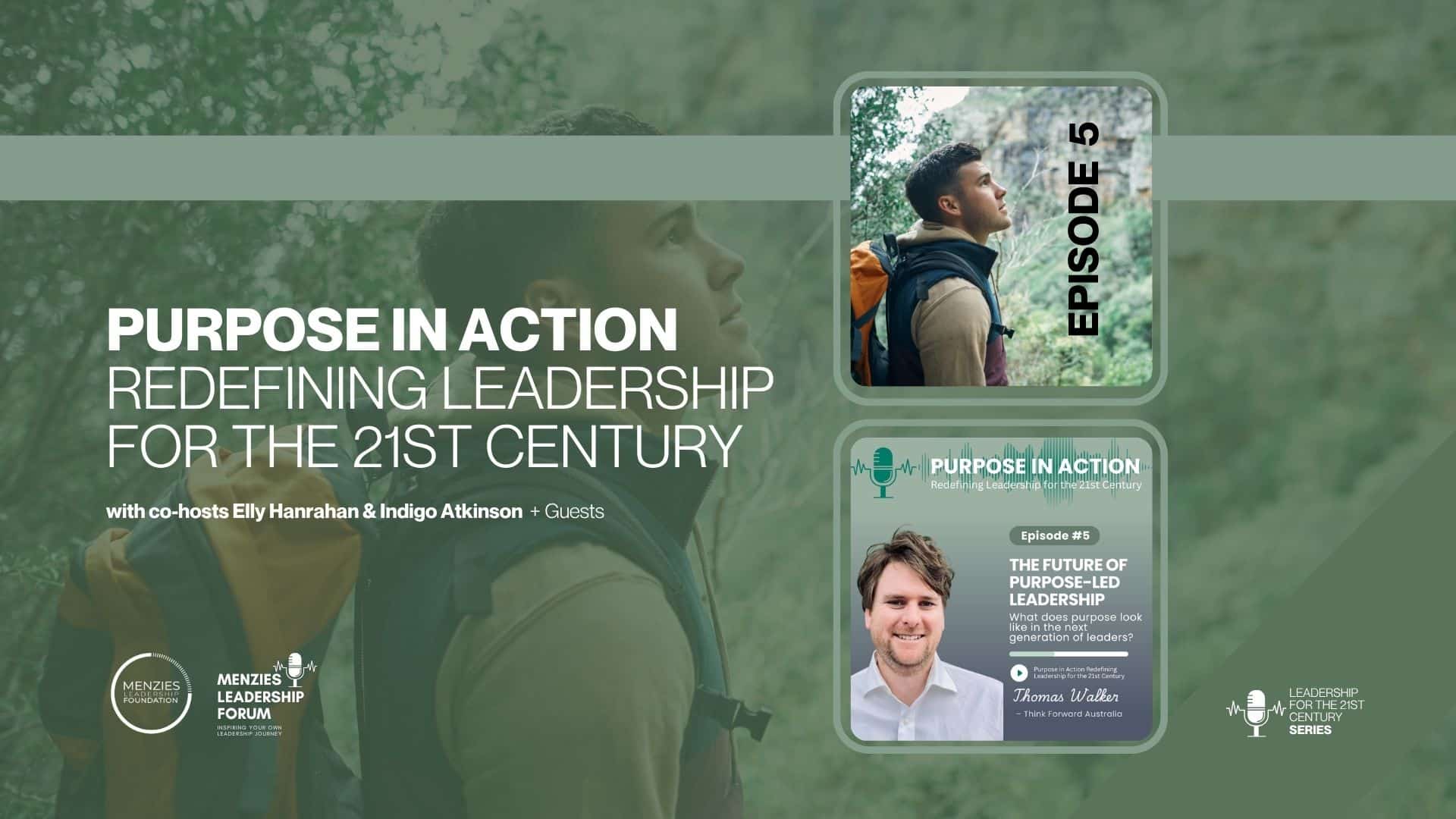
In Episode 5 of Purpose in Action: Redefining Leadership for the 21st Century, Thomas Walker — CEO of Think Forward Australia — explores what this next era of leadership demands. Drawing on his work at the intersection of economic policy, intergenerational equity and civic engagement, he reflects on how emerging leaders are redefining influence — not through authority, but through collaboration, clarity and impact.
Purpose, in this context, becomes not just a guiding principle, but a force for systems change.
A generation searching for agency
For Walker, purpose did not arrive as a singular moment of clarity. It emerged gradually — through experience, reflection and, at times, frustration.
He describes a “process of unlearning” — stepping away from a culture of disengagement and discovering that caring about politics, policy and public life is not only valid, but necessary.
At its core, his work is driven by a deep concern: that the systems shaping society — particularly economic systems — are no longer delivering equitable outcomes.
Rather than accepting that reality, he chose to act.
Leadership, in this sense, begins not with certainty, but with a willingness to engage — to step into uncomfortable spaces, to speak up, and to take responsibility for shaping the future.
Leadership without hierarchy
Walker challenges traditional notions of leadership as authority or position. Despite leading a national organisation, he resists defining himself by the title of CEO.
Instead, he describes leadership as something more distributed — grounded in teamwork, collaboration and shared ownership.
“I don’t really like the idea of leading,” he reflects. “It’s more about enabling others to do their best.”
This perspective reflects a broader shift in leadership thinking. As challenges become more complex and interconnected, no single individual holds all the answers. The role of a leader is less about directing and more about creating the conditions for collective success.
Purpose, in this context, is not held individually. It is co-created.
Reframing the economic narrative
At the centre of Walker’s work is a focus on intergenerational equity — the idea that economic systems should enable all Australians to lead secure and fulfilling lives.
For many younger Australians, he argues, that promise is no longer guaranteed.
Rising housing costs, economic insecurity and the long-term impacts of climate change have created a sense that the traditional social contract — work hard, and you will get ahead — is breaking down.
This is not simply a matter of perception. It is the result of decades of policy decisions that have prioritised wealth accumulation in some parts of society, while leaving others behind.
“Problem definition isn’t action,” Walker notes.
While there is growing consensus that these challenges exist, meaningful reform requires leadership that is willing to confront entrenched interests and reimagine existing systems.
Making complexity accessible
One of the defining features of Walker’s approach is his commitment to making complex policy issues understandable.
Economic systems, tax structures and public policy debates are often framed in technical language that can feel inaccessible to the broader community. This creates a barrier to participation — limiting who feels able to engage in shaping the future.
Walker sees this as both a challenge and an opportunity.
“If we can break these things down in simple, engaging ways,” he explains, “more people can be part of the conversation.”
Accessible communication is not a simplification of ideas. It is an expansion of agency. It allows individuals — particularly younger generations — to understand how systems operate, and to advocate for change.
In this way, data and behavioural insight become tools not just for analysis, but for engagement.
Reclaiming the collective
A recurring theme throughout the conversation is the tension between individualism and collective action.
For decades, societal narratives have emphasised personal responsibility — encouraging individuals to focus on their own economic success. While this approach has driven innovation and growth, it has also, at times, come at the expense of collective solutions.
Walker argues that many of the most pressing challenges of our time — from housing affordability to climate change — cannot be solved individually.
“They are collective problems,” he says. “And they require collective responses.”
Rebuilding that collective mindset will be critical for the next generation of leaders. It requires re-engaging with public institutions, participating in civic life, and recognising that long-term progress depends on shared effort.
The conditions for leadership
Yet the ability to engage is not evenly distributed.
Walker highlights a structural challenge facing younger generations: the increasing pressure of economic insecurity. For many, the demands of daily life — paying rent, managing debt, maintaining employment — leave little time or capacity to participate in broader societal conversations.
This has implications not only for individuals, but for the health of democracy itself.
If people lack the time, space or resources to think, reflect and engage, the pool of future leaders narrows.
Creating the conditions for leadership therefore becomes a systemic challenge. It requires policies and environments that enable people to contribute — not just survive.
Learning across generations
Despite these challenges, Walker remains optimistic.
One of the most encouraging trends he observes is the growing collaboration between generations. Experienced leaders, particularly those reflecting on their own legacy, are increasingly seeking to support and mentor younger voices.
These relationships offer a powerful exchange: deep expertise meets fresh perspective.
They also reinforce a key insight — that leadership is not confined to a single generation. It is an ongoing dialogue, shaped by those who have come before and those who are yet to lead.
What comes next
As the series concludes, a new vision of leadership begins to take shape.
It is less about authority, and more about agency.
Less about individual achievement, and more about collective impact.
Less about certainty, and more about the courage to engage with complexity.
The future of purpose-led leadership will be defined by those who can navigate this shift — who can connect insight with action, data with meaning, and individuals with systems.
And perhaps most importantly, those who can create the conditions for others to lead.
Because the future will not be shaped by a single voice.
It will be shaped by many — working together, with purpose.
________________________________________________________________________________________________________________
🎧 Listen to Episode 5 — THE FUTURE OF PURPOSE-LED LEADERSHIP on Purpose in Action Podcast Series.
________________________________________________________________________________________________________________