The Leadership Load Nobody Named

Leadership has not disappeared.
It has relocated.

Across organisations, communities, and civic life, leadership work increasingly falls to people who were never formally given the role — and rarely given the authority to match.

This shift is often described as the rise of distributed or collective leadership. In practice, however, what many people experience feels less intentional.

It feels like responsibility quietly moving downward through systems.

The work still needs to be done.
So someone does it.

When institutions struggle to keep pace with complexity, the tasks of leadership migrate toward those closest to the problem. Decisions deferred upward are delayed. Risks avoided institutionally are absorbed personally. Problems pushed outward land in communities, workplaces, and local relationships.

The system continues to function.

But only because someone is carrying its weight.

This dynamic is visible across everyday life.
When tensions arise within neighbourhoods, schools, or sporting clubs, it is often not formal authorities who step in first. It is the respected parent who helps calm a heated discussion, the volunteer organiser who keeps dialogue open when disagreement escalates, or the community member who quietly bridges divides.

These individuals rarely describe themselves as leaders.

Yet they carry the work of leadership.

Maintaining trust.
Preventing relationships from breaking down.
Holding conversations that others avoid.

The institution remains intact on paper.
The leadership work, however, has moved.

Within organisations the pattern is similar. Strategies are announced from the top, but the real work of navigating uncertainty happens in the middle and at the edges — where people translate direction into action while managing the human consequences of change.

Over time, this creates a widening gap between responsibility and authority.

People are expected to manage outcomes they cannot fully control. They uphold expectations they did not design. They absorb frustration directed toward decisions made elsewhere.

When things go wrong, accountability flows downward.
When decisions are made, power flows upward.

The imbalance can create moral strain.

Individuals who care deeply about the communities or teams they serve find themselves carrying burdens that were never formally recognised. Much of this labour is relational rather than technical: listening, mediating, calming tensions, sustaining trust.

This work rarely appears in leadership frameworks or performance metrics.

Yet it is often what keeps systems functioning.

The danger is not simply burnout. It is something quieter.

A gradual withdrawal of care.

When people feel they are carrying responsibility without the authority to shape outcomes, energy drains from systems. People continue performing their roles, but the deeper commitment that sustains institutions begins to erode.

Naming the leadership load matters because it makes visible what many people already feel.

Leadership has not become lighter.

It has simply become less visible.

As the coming decade unfolds, leadership will not be defined only by who holds formal positions.

It will be defined by who is willing — and able — to carry responsibility for the health of relationships, communities, and systems.

The future of leadership may depend less on who steps forward.

And more on whether we notice who has been carrying it all along.

About the Author
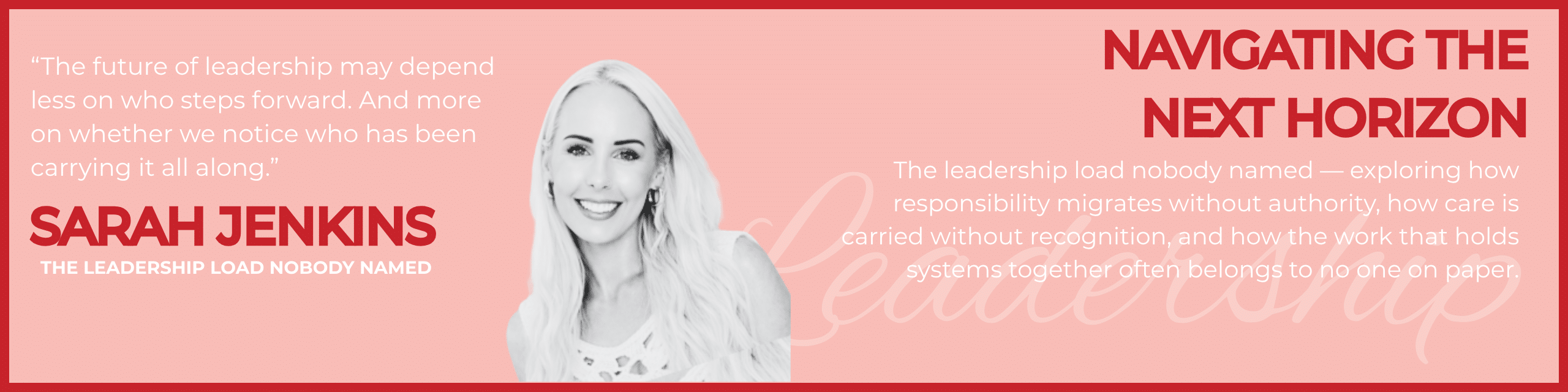
Sarah Jenkins is Director, Communications and Engagement at the Menzies Leadership Foundation, where she shapes national conversations on leadership, legitimacy and social cohesion. Her work sits at the intersection of narrative, systems change and public discourse, with a focus on how leadership is understood, practised and sustained in complex, contested environments.

Continue the Conversation
The questions raised in this piece are not abstract—they are playing out across institutions, communities and public life in real time. If this perspective resonates, or challenges your own, Sarah welcomes the opportunity to engage. Connect with Sarah Jenkins on LinkedIn to continue the conversation on leadership, legitimacy and the future of public trust.

The migration of responsibility without authority is not a management failure. It is a structural condition. Those already carrying this weight do not need it explained — they feel it in every conversation they were never asked to have, every crisis they absorbed without a title, every relationship they held together quietly, without credit.

What this essay offers is language for what you are already living — and the recognition that the strain you carry is not a sign of weakness. It is the cost of caring in systems that have not yet learned to see the work.

Those willing to sit with that recognition are already doing the deeper work. The next essay continues here: what happens when the people carrying the most are also the least protected, how informal leadership erodes when it goes unnamed, and what it means to lead with care in systems designed for compliance. Continue with us.

Related Posts

Natasha Eskinja

Digital Communications Coordinator

Natasha is driven by a profound passion for both creativity and analytics, a synergy that fosters authentic storytelling in the digital realm with both innovation and integrity. 

Throughout her career, she has consistently integrated the overarching marketing and communications narrative with the emotional connections of audiences. She is currently pursuing a Certificate in Society and the Individual from Flinders University, furthering her exploration of human behaviour and the critical importance of connectedness between organisations, individuals, and communities.

LinkedIn | natasha.eskinja@menziesfoundation.org.au

Sarah Jenkins

Strategic Communications Manager

Sarah has more than 18 years’ experience in communications and marketing leadership across a range of sectors.

Communications strategy and organisational growth is a continuing theme in Sarah’s career. Most recently, she leads the development of a Leadership Movement, evaluated by Menzies Viral Co-efficient Model; a contribution to the NFP. 

Sarah’s early career centred around best practice in marketing and communications which later culminated into the establishment of her very own agency. This work extensively spanned across PR, traditional media, event management, strategy, digital marketing, graphic design and business development consultancy. 

In 2019, Sarah joined the lean and robust team at the Menzies Foundation. She has since crafted the Foundation’s narrative and communication strategy. The development of this strategic communications platform is essential for ‘movement building’ and requires a strong strategic, management and communication skills set. Sarah has brought so much to this important work, which sits at the forefront of communication practice. 

Sarah continues to contribute to the NFP sector through her commitment to Purpose; as she reflects on her own leadership, builds her own leadership capability and contributes to the greater good. 

LinkedIn | sarah.jenkins@menziesfoundation.org.au | 0401 880 071

Rohan Martyres

Director, Strategy and Partnerships

Rohan has 15 years’ experience in facilitating cross-sector collaborations to address complex social and health challenges.  He has worked with the World Economic Forum in Australia, led an international conflict resolution field team in Nepal, and directed a 10-year £40m initiative to reduce health inequity in London.

Most recently, Rohan was Major Grants Development Manager at the Ian Potter Foundation.  He refined the foundation’s major grants strategy, and co-developed a series of large scale initiatives, including joint philanthropic-government funding for a new national organization to support place-based approaches across Australia.

Rohan has held several non-executive roles, including with an international NGO and with London Funders, the peak body of independent foundations in London.  He holds several qualifications including a graduate degree in innovation and strategy from the Judge Business School, University of Cambridge.

When Rohan isn’t exploring Melbourne’s creeks with his partner and 6yo daughter, he’s working on his currently weak Australian accent (after 15 years in the UK).

LinkedIn | rohan.martyres@menziesfoundation.org.au | 0404 505 954

Trudy Morrison

Operations Manager

A marketing and communications specialist with over 20 years experience in government, corporate and consumer marketing, Trudy brings her adaptive and organisational project management skills to the Menzies Foundation team. 

With a BA degree in Public Relations, Trudy began her career with the City of Melbourne and in magazine publishing, before moving into marketing communications consulting. She has worked in strategic marketing leadership roles with retail brands and enjoys juggling many projects and tasks simultaneously. Her skills were further enhanced when managing her own communications business representing industries across private education, financial services, aviation, government and the health industry. 

Trudy is passionate about leadership and all people being encouraged to reach their full potential through research and educational initiatives and opportunities throughout Australia. A skilled and accomplished writer and editor Trudy is enthusiastic about bringing her variety of skills to the Menzies Foundation team. 

LinkedIn | trudy.morrison@menziesfoundation.org.au | 0402 361 878

Liz Gillies

Chief Executive Officer

Liz Gillies has had over 25 years experience in a range of fields focused on initiatives for social impact. She has held roles in multiple sectors and academia.

In 2018, Liz was appointed CEO of the Menzies Foundation which aspires to build a leadership movement that supports Australians to pivot to purpose, build their leadership capability and contribute to the ‘greater good’.

Liz joined the Melbourne Business School in 2009 and was instrumental in establishing the Asia Pacific Social Impact Centre (APSIC) and The Centre for Ethical Leadership. In November 2011 she was appointed as research fellow to lead a partnership focused on strategic philanthropy which culminated in the release of the reports: Philanthropy: Towards a Better Practice Model (2018) and the Philanthropy: The Continued Journey to Real Impact and better Practice (2021).

Liz has extensive governance experience, having served on the Board of the Publish Galleries Association of Victoria, Social Firms Australia, Uniting Care Community Options, United Way Australia and the Development Committee of the Towards a Just Society Foundation. She is currently on the Philanthropy Reference Group of Barmal Bijiril and a Director of Philanthropy Australia.

LinkedIn | liz.gillies@menziesfoundation.org.au | 0416 112 703

Natasha Eskinja

Digital Communications Coordinator

Natasha is driven by a profound passion for both creativity and analytics, a synergy that fosters authentic storytelling in the digital realm with both innovation and integrity. 

Throughout her career, she has consistently integrated the overarching marketing and communications narrative with the emotional connections of audiences. She is currently pursuing a Certificate in Society and the Individual from Flinders University, furthering her exploration of human behaviour and the critical importance of connectedness between organisations, individuals, and communities.