Fairness at the Frontline

What does leadership demand when affordability becomes a daily pressure for
millions of families?

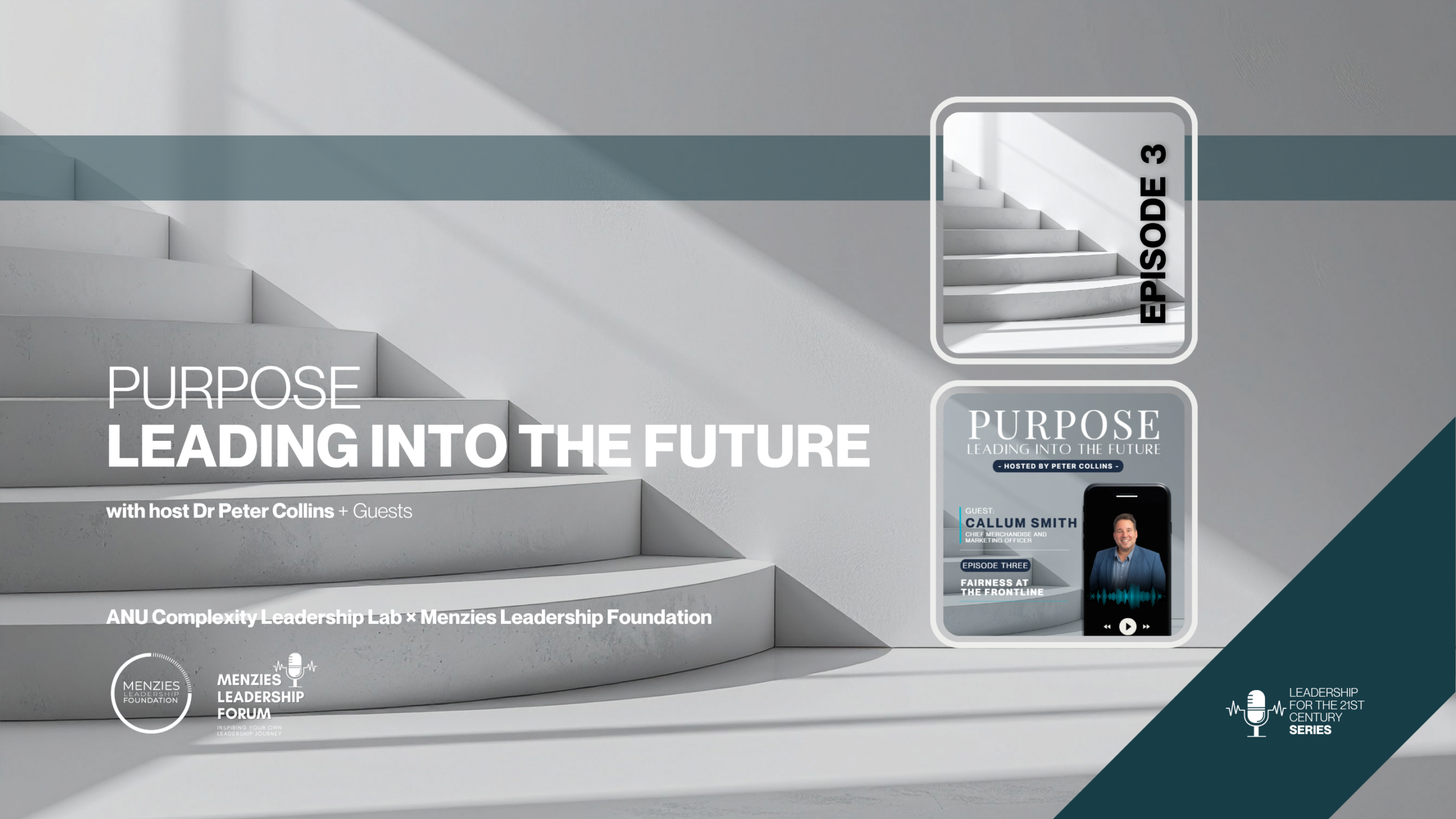
In Episode 3 of Purpose: Leading into the Future, Callum Smith — Chief Commercial Officer
at Kmart Australia and New Zealand — explores what it means to lead at the frontline of
economic pressure, where decisions about price, supply chains and customer value shape
everyday life for millions of Australians.

As the series continues its exploration of leadership as a practice of guardianship, this
conversation shifts into the realities of retail — a sector often overlooked in leadership
discourse, yet deeply connected to questions of fairness, dignity and trust.

Because in a cost-of-living crisis, affordability is no longer just a commercial issue.

It is a social one.
The human impact of price

For Smith, the connection between leadership and affordability is deeply personal.

Raised between Melbourne and the regional communities of Albury-Wodonga, he describes a childhood grounded in hard work, community and financial constraint. Lawn mowing, washing cars and early casual work shaped not only his work ethic, but his understanding of the pressures many families quietly carry.

That grounding still shapes how he leads today.

Kmart’s purpose — making everyday living brighter — is not treated internally as a slogan. It is viewed as a practical responsibility to help families navigate increasingly difficult economic conditions.

“We know the power of five dollars,” Smith explains.

And in today’s environment, that difference matters.

Retail as a frontline social system

Retail is often framed through the language of commerce — sales, margins, productivity and growth.

But this conversation reveals something broader.

Retail operates inside the lived reality of households.

It sits at the intersection of:

  • Inflation
  • Housing pressure
  • Food insecurity
  • Consumer anxiety
  • Social expectation

This creates a different kind of leadership challenge.

How do you maintain affordability while navigating rising supply chain costs?
How do you protect long-term sustainability without transferring every pressure onto customers?
And how do you make decisions that are commercially responsible while remaining socially conscious?

These are not abstract strategic questions.

They play out daily — in trolley choices, family budgets and moments of quiet financial stress.

The dignity hidden in everyday purchases

One story shared during the episode captures this powerfully.

A single mother wrote anonymously to Kmart explaining that she had previously avoided letting her daughter attend birthday parties because she could not afford gifts that would avoid social judgement.

Kmart changed that.

Affordable products allowed her daughter to participate — not just economically, but socially.

It is a small story on the surface.

But underneath it sits a deeper truth:

Affordability is connected to dignity, belonging and inclusion.

Leadership at the frontline therefore becomes about more than reducing prices.

It becomes about reducing exclusion.

Purpose under pressure

This responsibility becomes even more significant during periods of economic volatility.

As global pressures intensified — fuel costs, shipping disruptions, inflation and supply chain instability — Kmart faced the same pressures affecting retailers worldwide.

But Smith describes a clear organisational commitment:

To absorb as much pressure as possible before passing costs on to customers.

This reflects one of the defining themes of the Purpose: Leading into the Future series:

Purpose is tested most meaningfully under constraint.

When conditions are stable, values are easy to articulate.
When systems are under pressure, they become harder — and more important — to uphold.

Fairness across the system

A central insight of the episode is that fairness does not exist in isolation.

Retail sits inside a wider ecosystem of:

  • Suppliers
  • Logistics networks
  • Workers
  • Communities
  • Customers

Every pricing decision reflects trade-offs somewhere else in the system.

This is why Smith repeatedly returns to the importance of long-term thinking.

Rather than pursuing short-term gains, the organisation focuses on sustainability, consistency and trust — absorbing shocks where possible and making decisions designed to strengthen resilience over time.

This approach is reinforced through the broader Wesfarmers philosophy of “moderate shareholder returns” and long-term stewardship — a model that prioritises endurance over short-term maximisation.

Leadership as consistency

One of the strongest themes throughout the conversation is the role of consistency in leadership.

Smith points to:

  • Stable leadership
  • Stable strategy
  • Stable values
  • Stable purpose

as critical factors in building organisational trust and resilience.

This stability matters particularly in uncertain environments.

When customers are anxious and employees are under pressure, leadership clarity becomes a form of reassurance.

Purpose provides continuity when external conditions are volatile.

Culture built through everyday behaviour

The episode also offers insight into how large organisations sustain culture at scale.

With more than 50,000 employees — many beginning casual work at 15 or 16 years old — the challenge is not simply operational.

It is cultural.

How do you embed purpose across generations, roles and regions?

The answer lies in repetition, storytelling and connection:

  • Sharing customer stories
  • Reinforcing values consistently
  • Celebrating moments of impact
  • Using digital platforms to build alignment across the workforce

This reflects another key theme emerging across the series:

Purpose is sustained not through occasional speeches, but through repeated everyday reinforcement.

Doing the right thing when it matters

Perhaps the clearest example of purpose in action came during COVID.

When stores were forced to close, leadership made the decision to continue paying team members — despite the significant commercial impact.

Importantly, Smith describes this not as a prolonged commercial debate, but as a values-based decision made quickly because it was understood internally as “the right thing to do.”

This distinction matters.

Purpose becomes most visible not when conditions are easy, but when organisations face difficult trade-offs between commercial pressure and human responsibility.

Learning through openness

No organisation operates perfectly.

Smith is candid about the importance of transparency when mistakes occur.

At Kmart, there is an emphasis on ensuring “bad news travels faster than good news” — encouraging openness, reflection and continuous improvement.

This creates a culture where:

  • Issues are surfaced early
  • Decisions are reviewed honestly
  • Diverse perspectives are encouraged
  • Learning becomes part of leadership practice

In complex systems, trust is not built through perfection.

It is built through responsiveness, humility and accountability.

Purpose beyond the individual

One of the most striking reflections in the conversation is Smith’s description of leadership evolving from “I” to “we.”

Earlier career ambition gradually gave way to a broader understanding of leadership:

  • Developing others
  • Building teams
  • Creating long-term impact
  • Leaving organisations stronger than before

This transition mirrors the broader arc of the podcast series itself.

Purpose-led leadership ultimately shifts focus:

  • From self → to stewardship
  • From achievement → to contribution

From status → to responsibility

What this means for leadership

This episode expands the definition of leadership in important ways.

It reminds us that leadership is not confined to government, finance or institutions.

It exists:

  • In supermarkets
  • In retail stores
  • In supply chains
  • In pricing decisions
  • In customer interactions

And increasingly, it exists in the choices organisations make about fairness during difficult times.

Looking ahead

As Purpose: Leading into the Future continues, this conversation highlights a critical challenge for modern leadership:

How do organisations remain commercially sustainable while protecting dignity, access and trust?

Because in periods of economic pressure, people remember more than products.

They remember:

  • Whether organisations showed up
  • Whether they acted fairly
  • Whether they understood the realities people were facing

And ultimately, whether purpose remained visible when pressure intensified.

🎧 Listen to Episode 3 — Fairness at the Frontline — from the Purpose: Leading into the Future podcast series.

Australia’s retail and commercial systems are not failing families because of a lack of ambition. They are failing when organisations treat affordability as a commercial metric rather than a social responsibility — and Callum Smith’s leadership at Kmart challenges that framing directly. Through his work, he is making the case that genuine impact in retail requires holding price, dignity and long-term trust together as a single system of value — one that measures its success not just in margins and market share, but in whether a child can attend a birthday party, and whether a family feels seen.

His work is a reminder that the most important leadership questions are not always strategic ones. Sometimes they begin with a letter from a single mother — and what it means for an organisation to take responsibility for that. Purpose, in Callum’s framing, is not a brand promise. It is a decision-making framework — a way of holding both commercial sustainability and human dignity as non-negotiable, even when supply chain pressures, inflation and shareholder expectations pull in different directions.

At the Menzies Leadership Foundation, this is precisely the kind of leadership we exist to support: grounded in lived experience, connecting organisational ambition to equity of access, and willing to rethink how essential systems serve all Australians — not just those who are easy to reach. Applications for the 2026 Global Voices Fellowship are now open. If you are committed to leadership that bridges purpose and practice and champions the wellbeing of communities, we invite you to explore the Fellowship and stay connected with the Menzies Leadership Foundation’s emerging leadership community.

Related Posts

Natasha Eskinja

Digital Communications Coordinator

Natasha is driven by a profound passion for both creativity and analytics, a synergy that fosters authentic storytelling in the digital realm with both innovation and integrity. 

Throughout her career, she has consistently integrated the overarching marketing and communications narrative with the emotional connections of audiences. She is currently pursuing a Certificate in Society and the Individual from Flinders University, furthering her exploration of human behaviour and the critical importance of connectedness between organisations, individuals, and communities.

LinkedIn | natasha.eskinja@menziesfoundation.org.au

Sarah Jenkins

Strategic Communications Manager

Sarah has more than 18 years’ experience in communications and marketing leadership across a range of sectors.

Communications strategy and organisational growth is a continuing theme in Sarah’s career. Most recently, she leads the development of a Leadership Movement, evaluated by Menzies Viral Co-efficient Model; a contribution to the NFP. 

Sarah’s early career centred around best practice in marketing and communications which later culminated into the establishment of her very own agency. This work extensively spanned across PR, traditional media, event management, strategy, digital marketing, graphic design and business development consultancy. 

In 2019, Sarah joined the lean and robust team at the Menzies Foundation. She has since crafted the Foundation’s narrative and communication strategy. The development of this strategic communications platform is essential for ‘movement building’ and requires a strong strategic, management and communication skills set. Sarah has brought so much to this important work, which sits at the forefront of communication practice. 

Sarah continues to contribute to the NFP sector through her commitment to Purpose; as she reflects on her own leadership, builds her own leadership capability and contributes to the greater good. 

LinkedIn | sarah.jenkins@menziesfoundation.org.au | 0401 880 071

Rohan Martyres

Director, Strategy and Partnerships

Rohan has 15 years’ experience in facilitating cross-sector collaborations to address complex social and health challenges.  He has worked with the World Economic Forum in Australia, led an international conflict resolution field team in Nepal, and directed a 10-year £40m initiative to reduce health inequity in London.

Most recently, Rohan was Major Grants Development Manager at the Ian Potter Foundation.  He refined the foundation’s major grants strategy, and co-developed a series of large scale initiatives, including joint philanthropic-government funding for a new national organization to support place-based approaches across Australia.

Rohan has held several non-executive roles, including with an international NGO and with London Funders, the peak body of independent foundations in London.  He holds several qualifications including a graduate degree in innovation and strategy from the Judge Business School, University of Cambridge.

When Rohan isn’t exploring Melbourne’s creeks with his partner and 6yo daughter, he’s working on his currently weak Australian accent (after 15 years in the UK).

LinkedIn | rohan.martyres@menziesfoundation.org.au | 0404 505 954

Trudy Morrison

Operations Manager

A marketing and communications specialist with over 20 years experience in government, corporate and consumer marketing, Trudy brings her adaptive and organisational project management skills to the Menzies Foundation team. 

With a BA degree in Public Relations, Trudy began her career with the City of Melbourne and in magazine publishing, before moving into marketing communications consulting. She has worked in strategic marketing leadership roles with retail brands and enjoys juggling many projects and tasks simultaneously. Her skills were further enhanced when managing her own communications business representing industries across private education, financial services, aviation, government and the health industry. 

Trudy is passionate about leadership and all people being encouraged to reach their full potential through research and educational initiatives and opportunities throughout Australia. A skilled and accomplished writer and editor Trudy is enthusiastic about bringing her variety of skills to the Menzies Foundation team. 

LinkedIn | trudy.morrison@menziesfoundation.org.au | 0402 361 878

Liz Gillies

Chief Executive Officer

Liz Gillies has had over 25 years experience in a range of fields focused on initiatives for social impact. She has held roles in multiple sectors and academia.

In 2018, Liz was appointed CEO of the Menzies Foundation which aspires to build a leadership movement that supports Australians to pivot to purpose, build their leadership capability and contribute to the ‘greater good’.

Liz joined the Melbourne Business School in 2009 and was instrumental in establishing the Asia Pacific Social Impact Centre (APSIC) and The Centre for Ethical Leadership. In November 2011 she was appointed as research fellow to lead a partnership focused on strategic philanthropy which culminated in the release of the reports: Philanthropy: Towards a Better Practice Model (2018) and the Philanthropy: The Continued Journey to Real Impact and better Practice (2021).

Liz has extensive governance experience, having served on the Board of the Publish Galleries Association of Victoria, Social Firms Australia, Uniting Care Community Options, United Way Australia and the Development Committee of the Towards a Just Society Foundation. She is currently on the Philanthropy Reference Group of Barmal Bijiril and a Director of Philanthropy Australia.

LinkedIn | liz.gillies@menziesfoundation.org.au | 0416 112 703

Natasha Eskinja

Digital Communications Coordinator

Natasha is driven by a profound passion for both creativity and analytics, a synergy that fosters authentic storytelling in the digital realm with both innovation and integrity. 

Throughout her career, she has consistently integrated the overarching marketing and communications narrative with the emotional connections of audiences. She is currently pursuing a Certificate in Society and the Individual from Flinders University, furthering her exploration of human behaviour and the critical importance of connectedness between organisations, individuals, and communities.