The Future of Human Leadership 

Insights from Professor David Day’s 2025 Public Oration + Podcast 

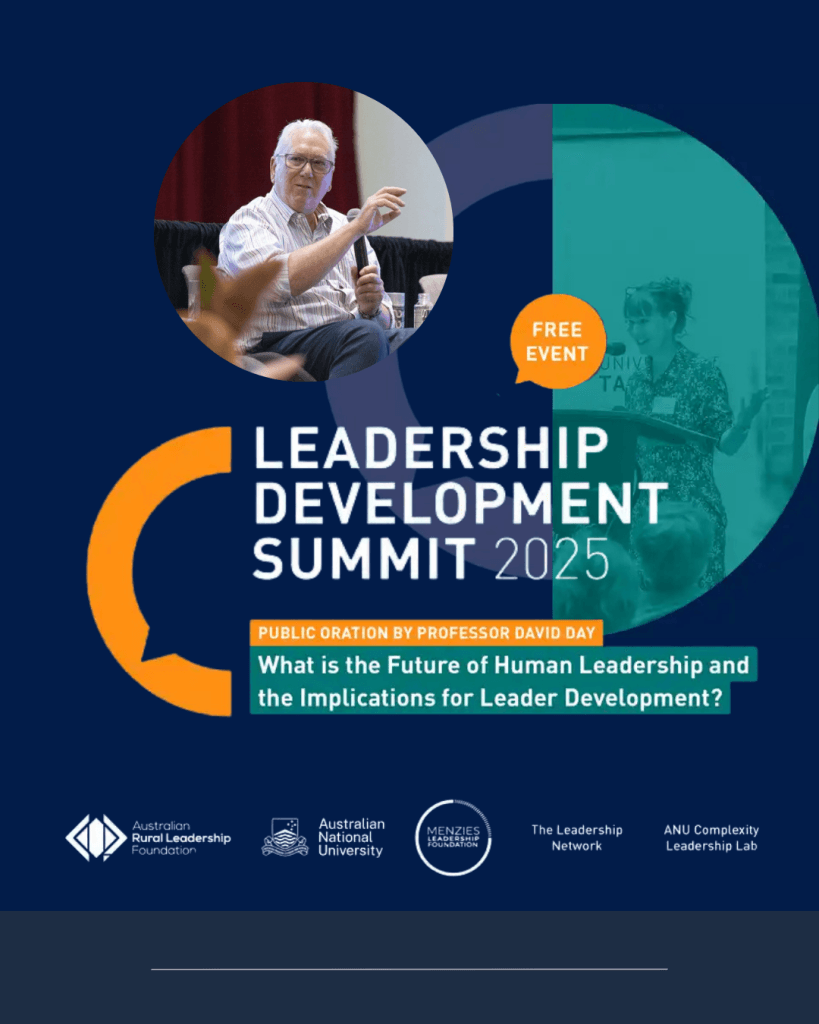
At the 2025 Leadership Development Summit, the Menzies Leadership Foundation, ANU and the Australian Rural Leadership Foundation hosted a landmark Public Oration delivered by Professor David Day, a globally recognised scholar of leadership development. The oration, paired with the companion episode of the Future of Leadership Development podcast, set out one of the clearest and most future-focused explorations of what leadership must become in a world defined by complexity and rapid technological change. 

Together, these two platforms offer a unified message: our leadership models must evolve as fast as the world around us.
A Leadership Landscape Reshaped by Complexity 

Across industries, communities and systems, leaders are facing conditions that outpace traditional approaches: geopolitical instability, climate disruption, declining institutional trust, social fragmentation, and the transformative force of AI. 

Both the podcast and oration emphasise that these challenges can no longer be met by individual capability alone. Leadership is shifting from a personal trait to a collective capacity — something exercised across teams, networks and communities, rather than concentrated at the top.

This reframing positions leadership as a public good: an ability we must cultivate widely, not selectively. 

AI as an Accelerant — Not a Replacement 

One of the strongest themes emerging from Professor Day’s work is the recognition that AI will profoundly reshape leadership development. Not by replacing leaders, but by transforming how leadership capability is built. 

AI enables: 

  • personalised diagnostics and assessment, 
  • instant behavioural insights, 
  • ongoing coaching and learning support, 
  • real-time simulations and scenario testing, 
  • and development embedded directly into day-to-day work. 

This marks a shift away from episodic, program-based learning toward continuous, adaptive developmental systems. 

Yet the human dimensions of leadership remain irreplaceable: judgment, ethics, discomfort, lived experience, creativity and moral reasoning — all essential for navigating uncertainty and building trust.

Leadership 3.0: A New Model for a New Era 

A central contribution of the oration is a renewed framing of leadership as the capacity to: 
create direction, generate alignment and build commitment — regardless of role, hierarchy or function.

This model opens the door to: 

  • distributed and shared leadership, 
  • cross-boundary collaboration, 
  • team- and network-based leadership, 
  • and AI-supported sensemaking in complex systems. 

It also reinforces a core idea: everyone can contribute to leadership, and developing this shared capability is critical for societal resilience. 

From Courses to Systems: Rethinking Development 

A consistent insight across the oration and podcast is the need to shift away from stand-alone courses and programs. Research and practice increasingly show that development dissipates when people return to unchanged environments.

The future lies in developmental systems — leadership embedded in real work through: 

  • small, repeated experiments, 
  • ongoing reflection, 
  • collaborative problem-solving, 
  • relational practice, 
  • and technology-enabled feedback loops.

This approach equips leaders and teams not just to perform, but to adapt, learn and respond to complex challenges over time. 

A Shared Invitation to Shape What Comes Next 

The combined message of the oration and podcast is clear: 
Leadership must evolve — and we all play a role in shaping its next chapter. 

We stand at a moment where human creativity, ethical judgment and collective capability matter more than ever, even as AI accelerates what is possible. Building leadership for the

greater good requires developing not only individuals, but the systems and conditions that enable people to learn, collaborate and act with purpose. 

WATCH & LISTEN 

🎥 Watch the 2025 Public Oration by Professor David Day 

🎧 Listen to the companion podcast: 
“Leadership, Complexity & the Future of Development” 

At the Menzies Leadership Foundation, we see leadership entering uncharted territory. The challenges we face demand more than individual capability—they require collective capacity and a fundamental reimagining of how we develop leaders.

Drawing on Professor David Day’s landmark 2025 Public Oration, Leadership 3.0 reframes leadership as a public good: the capacity to create direction, generate alignment and build commitment—across teams, networks and communities, not concentrated at the top.

As AI accelerates what’s possible, the human dimensions of leadership matter more than ever: judgment, ethics, creativity and moral reasoning. The future belongs to those willing to lead collectively, learn continuously and build leadership as shared capability.

We stand at a threshold. Join us in shaping what comes next.

Explore the oration. Engage with the Menzies Leadership Foundation. Help us reimagine leadership for the world we’re entering.

Natasha Eskinja

Digital Communications Coordinator

Natasha is driven by a profound passion for both creativity and analytics, a synergy that fosters authentic storytelling in the digital realm with both innovation and integrity. 

Throughout her career, she has consistently integrated the overarching marketing and communications narrative with the emotional connections of audiences. She is currently pursuing a Certificate in Society and the Individual from Flinders University, furthering her exploration of human behaviour and the critical importance of connectedness between organisations, individuals, and communities.

LinkedIn | natasha.eskinja@menziesfoundation.org.au

Sarah Jenkins

Strategic Communications Manager

Sarah has more than 18 years’ experience in communications and marketing leadership across a range of sectors.

Communications strategy and organisational growth is a continuing theme in Sarah’s career. Most recently, she leads the development of a Leadership Movement, evaluated by Menzies Viral Co-efficient Model; a contribution to the NFP. 

Sarah’s early career centred around best practice in marketing and communications which later culminated into the establishment of her very own agency. This work extensively spanned across PR, traditional media, event management, strategy, digital marketing, graphic design and business development consultancy. 

In 2019, Sarah joined the lean and robust team at the Menzies Foundation. She has since crafted the Foundation’s narrative and communication strategy. The development of this strategic communications platform is essential for ‘movement building’ and requires a strong strategic, management and communication skills set. Sarah has brought so much to this important work, which sits at the forefront of communication practice. 

Sarah continues to contribute to the NFP sector through her commitment to Purpose; as she reflects on her own leadership, builds her own leadership capability and contributes to the greater good. 

LinkedIn | sarah.jenkins@menziesfoundation.org.au | 0401 880 071

Rohan Martyres

Director, Strategy and Partnerships

Rohan has 15 years’ experience in facilitating cross-sector collaborations to address complex social and health challenges.  He has worked with the World Economic Forum in Australia, led an international conflict resolution field team in Nepal, and directed a 10-year £40m initiative to reduce health inequity in London.

Most recently, Rohan was Major Grants Development Manager at the Ian Potter Foundation.  He refined the foundation’s major grants strategy, and co-developed a series of large scale initiatives, including joint philanthropic-government funding for a new national organization to support place-based approaches across Australia.

Rohan has held several non-executive roles, including with an international NGO and with London Funders, the peak body of independent foundations in London.  He holds several qualifications including a graduate degree in innovation and strategy from the Judge Business School, University of Cambridge.

When Rohan isn’t exploring Melbourne’s creeks with his partner and 6yo daughter, he’s working on his currently weak Australian accent (after 15 years in the UK).

LinkedIn | rohan.martyres@menziesfoundation.org.au | 0404 505 954

Trudy Morrison

Operations Manager

A marketing and communications specialist with over 20 years experience in government, corporate and consumer marketing, Trudy brings her adaptive and organisational project management skills to the Menzies Foundation team. 

With a BA degree in Public Relations, Trudy began her career with the City of Melbourne and in magazine publishing, before moving into marketing communications consulting. She has worked in strategic marketing leadership roles with retail brands and enjoys juggling many projects and tasks simultaneously. Her skills were further enhanced when managing her own communications business representing industries across private education, financial services, aviation, government and the health industry. 

Trudy is passionate about leadership and all people being encouraged to reach their full potential through research and educational initiatives and opportunities throughout Australia. A skilled and accomplished writer and editor Trudy is enthusiastic about bringing her variety of skills to the Menzies Foundation team. 

LinkedIn | trudy.morrison@menziesfoundation.org.au | 0402 361 878

Liz Gillies

Chief Executive Officer

Liz Gillies has had over 25 years experience in a range of fields focused on initiatives for social impact. She has held roles in multiple sectors and academia.

In 2018, Liz was appointed CEO of the Menzies Foundation which aspires to build a leadership movement that supports Australians to pivot to purpose, build their leadership capability and contribute to the ‘greater good’.

Liz joined the Melbourne Business School in 2009 and was instrumental in establishing the Asia Pacific Social Impact Centre (APSIC) and The Centre for Ethical Leadership. In November 2011 she was appointed as research fellow to lead a partnership focused on strategic philanthropy which culminated in the release of the reports: Philanthropy: Towards a Better Practice Model (2018) and the Philanthropy: The Continued Journey to Real Impact and better Practice (2021).

Liz has extensive governance experience, having served on the Board of the Publish Galleries Association of Victoria, Social Firms Australia, Uniting Care Community Options, United Way Australia and the Development Committee of the Towards a Just Society Foundation. She is currently on the Philanthropy Reference Group of Barmal Bijiril and a Director of Philanthropy Australia.

LinkedIn | liz.gillies@menziesfoundation.org.au | 0416 112 703

Natasha Eskinja

Digital Communications Coordinator

Natasha is driven by a profound passion for both creativity and analytics, a synergy that fosters authentic storytelling in the digital realm with both innovation and integrity. 

Throughout her career, she has consistently integrated the overarching marketing and communications narrative with the emotional connections of audiences. She is currently pursuing a Certificate in Society and the Individual from Flinders University, furthering her exploration of human behaviour and the critical importance of connectedness between organisations, individuals, and communities.