
Purpose may begin with an individual insight, but it rarely succeeds alone.
In an era defined by complex, global challenges, leadership is no longer a solo pursuit. The problems that shape our future — climate change, geopolitical uncertainty, economic transition — demand collaboration across borders, institutions and ideologies.
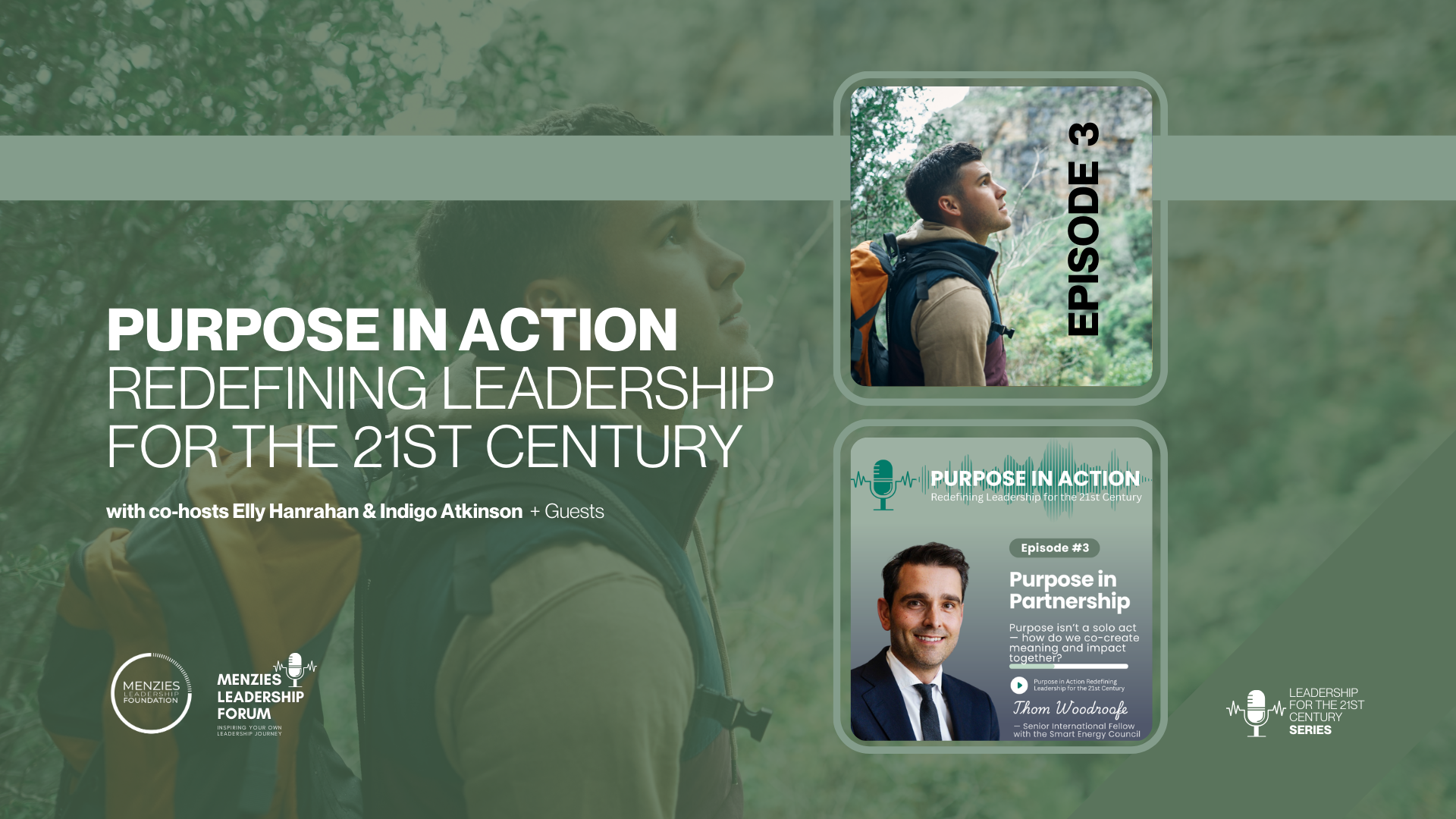
In Episode 3 of Purpose in Action: Redefining Leadership for the 21st Century, Thom Woodroofe — Senior International Fellow with the Smart Energy Council and founding CEO of Global Voices — reflects on what it takes to build that collaboration. Drawing on a career spanning international diplomacy, climate negotiations and global policy networks, he argues that leadership today is fundamentally relational. Progress happens not through individual authority, but through the ability to bring diverse actors together around a shared purpose.
Purpose, in other words, finds its power in partnership.
Bridging across difference
Early in the conversation, Woodroofe reflects on the founding of Global Voices — an organisation he established in his early twenties to enable young Australians to engage with global policy debates.
From the beginning, the organisation was intentionally non-partisan, bringing together leaders from across the political spectrum. That design choice was not simply idealistic — it was practical.
“If you care about getting stuff done,” he explains, “the worst way to do that is to be a partisan zealot.”
Politics has an essential role in democratic societies, he notes. But solving complex problems — from climate change to international diplomacy — requires the ability to work with people whose perspectives differ from your own.
Purpose-driven leadership therefore demands a deliberate effort to resist echo chambers. Progress rarely emerges from ideological purity. It emerges from collaboration across difference.
Leadership in a multipolar world
Woodroofe’s career has unfolded largely in the realm of international diplomacy, particularly through his involvement in global climate negotiations and multilateral institutions.
From helping secure the 2015 Paris Climate Agreement to advising former Prime Minister Kevin Rudd during his tenure as Australia’s Ambassador to the United States, his work has repeatedly required navigating complex international partnerships.
Today, he argues, that collaborative instinct is more important than ever.
Global institutions face profound headwinds. Trust in multilateral cooperation is under pressure, geopolitical tensions are rising, and progress on climate action is increasingly fragile. Yet the scale of the challenges facing the world — climate change, energy transition, global security — makes partnership unavoidable.
“There’s no other mechanism to deal with this,” he says of international climate negotiations. “If you believe climate change must be addressed, there’s no other game in town.”
In this context, middle powers like Australia have a unique opportunity. Rather than retreating into caution, Woodroofe suggests that countries with strong diplomatic networks and constructive reputations can act as conveners — mobilising coalitions, fostering dialogue, and advancing shared solutions.
But doing so requires clarity of purpose.
Values before strategy
For Woodroofe, one of the most significant challenges in Australian foreign policy is not a lack of capability, but a lack of coherence around national values.
Australia’s diplomatic strategy has traditionally been described through geographic pillars — the US alliance, engagement with Asia, and participation in multilateral institutions. But these frameworks describe relationships, not purpose.
“What do we want to stand for on the world stage?” he asks.
Without a clear answer, partnerships risk becoming purely transactional — focused on managing crises rather than advancing shared goals.
Values, by contrast, provide direction. They create a “guiding star” that enables countries to navigate geopolitical complexity while remaining anchored to a larger vision.
Climate diplomacy begins at home
While much of Woodroofe’s career has been spent negotiating internationally, he emphasises that global leadership begins domestically.
Australia’s credibility on climate policy, he argues, ultimately depends on its ability to build durable support for the energy transition at home.
For many Australians, debates about net-zero targets or global emissions agreements feel abstract — particularly when day-to-day pressures such as the cost of living dominate public attention.
To build a broader coalition for change, climate policy must demonstrate tangible benefits in people’s lives.
That means practical measures: rooftop solar, household energy efficiency, improved resilience to extreme weather, and economic opportunities emerging from new clean-energy industries. These policies are not simply environmental measures; they are economic and social ones.
“Policy needs to make sense for people here and now,” Woodroofe explains.
Expanding the constituency of support for climate action, particularly in regional and middle-income communities, will determine whether Australia can sustain long-term progress.
From resource power to clean energy superpower
One of the most compelling ideas emerging in Australia’s climate debate is the concept of becoming a renewable energy export superpower.
For more than a century, Australia’s prosperity has been tied to mineral resources. But the global transition to clean energy presents an opportunity to redefine that economic model.
Exporting green hydrogen, green iron and green steel could position Australia at the forefront of a new industrial era — one that aligns climate ambition with economic growth.
Yet Woodroofe acknowledges that for many Australians this vision still feels distant.
Transformational change rarely occurs through a single policy announcement. It unfolds through tangible steps — new industries, investment frameworks, and partnerships between governments, businesses and communities.
As these developments accumulate, the abstract vision of a clean-energy future begins to feel real.
What effective leaders understand
As the episode draws to a close, Woodroofe reflects on the leadership lessons he has observed throughout his career.
Two qualities stand out.
The first is attention. The most effective leaders, he notes, recognise everyone in the room — not just those who appear powerful. Influence often resides in unexpected places, and genuine engagement builds the trust necessary for collaboration.
The second is the ability to connect vision with execution.
Some leaders are exceptional visionaries. Others excel at operational delivery. But the most effective leaders combine both.
“They can paint the vision,” he explains, “and also understand how to actually get it done.”
It is this dual capacity — to inspire and to implement — that turns ideas into impact.
Purpose as a shared endeavour
Across the Purpose in Action series, a clear pattern is emerging.
Purpose begins with reflection.
It is tested through decisions.
And ultimately, it becomes powerful through partnership.
Whether negotiating international agreements, building bipartisan organisations, or mobilising domestic constituencies for change, leadership in the 21st century depends less on individual authority and more on collective capability.
Purpose, Woodroofe reminds us, is not something leaders carry alone.
It is something they build — together.
_____________________________________________________________________________________________
🎧 Listen to Episode 3 — Purpose in partnership on Purpose in Action Podcast Series.
____________________________________________________________________________________