When Leadership Loses Its Mandate

Leadership today is not faltering because capable people are absent.
It is faltering because the mandate to lead can no longer be assumed.

Across institutions, organisations, and public life, leaders increasingly discover that authority — once conferred by role, expertise, or election — no longer guarantees consent. Decisions are questioned before they are implemented. Intentions are scrutinised alongside outcomes. Credibility, once lost, is difficult to restore through performance alone.

This is not simply a crisis of trust.
It is a crisis of legitimacy.

Trust implies a relationship that can be repaired. Legitimacy asks a more fundamental question: who has the right to lead at all?

In earlier eras, leadership authority often rested on shared assumptions — that institutions broadly represented the collective interest, that expertise deserved deference, and that formal roles carried inherent standing. Those assumptions have weakened. Today leaders are judged not only on competence, but on alignment with values, lived experience, and perceived moral credibility.

As a result, leaders are no longer expected simply to make good decisions. They are expected to justify why they are the ones making them. This shift becomes visible in moments when leadership action is simultaneously demanded and resisted.
Consider the reaction when respected institutions — universities, cultural organisations, sporting bodies, or community leaders — speak publicly on complex social issues. What once might have been accepted as a contribution to public debate now often triggers a different response. People ask whose voices were included in the decision to speak, whose experiences informed the perspective offered, and whether the institution itself holds the legitimacy to lead that conversation.

The debate quickly moves beyond the substance of what is said.

It becomes a debate about who has the standing to say it.

When legitimacy becomes unstable, the work of leadership grows heavier. Leaders spend more time explaining, defending, and signalling intent to multiple audiences whose expectations diverge sharply. Decision-making slows. Scrutiny intensifies. The margin for error narrows.

Yet opting out of leadership is rarely possible. The challenges leaders face — social division, technological disruption, institutional strain — do not pause while authority is debated.

The result is a paradox.

Leadership is resisted and demanded at the same time. People question authority while also calling for decisive action. This tension is not evidence of failing leadership. It is a structural condition of our time.

Where legitimacy was once inherited, it is now provisional. It must be built and rebuilt through behaviour rather than position.

Listening without defensiveness.
Naming trade-offs honestly.
Holding disagreement without collapsing into certainty.

These relational qualities increasingly determine whether leadership is accepted.

Importantly, legitimacy is no longer singular. A leader may be seen as credible by one group and rejected by another simultaneously. Leadership models built on unified followership struggle under this reality.

One of the defining challenges of the coming decade will therefore be leading without the assurance of universal permission. Waiting for complete consensus can become a form of paralysis. Acting without legitimacy risks deepening fracture. Leaders must navigate this tension knowing that inaction carries consequences of its own.

Leadership in this environment demands a different orientation.

Leadership has not disappeared. But the conditions under which it operates have changed profoundly.

The question facing leaders now is not whether they hold authority. It is whether they can sustain legitimacy in environments where permission must be continually earned.

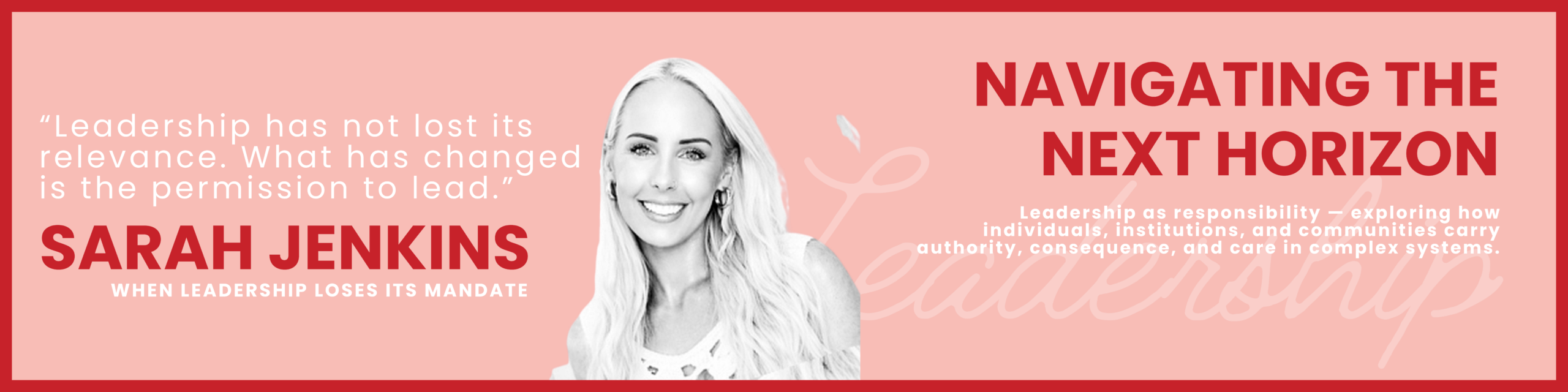
Leadership has not lost its relevance. What has changed is the permission to lead.

About the Author
Sarah Jenkins is Director, Communications and Engagement at the Menzies Leadership Foundation, where she shapes national conversations on leadership, legitimacy and social cohesion. Her work sits at the intersection of narrative, systems change and public discourse, with a focus on how leadership is understood, practised and sustained in complex, contested environments.

Continue the Conversation
The questions raised in this piece are not abstract—they are playing out across institutions, communities and public life in real time. If this perspective resonates, or challenges your own, Sarah welcomes the opportunity to engage. Connect with Sarah Jenkins on LinkedIn to continue the conversation on leadership, legitimacy and the future of public trust.

The shift from inherited authority to earned legitimacy is not a trend. It is structural. Those who have felt the weight of this shift already know this intuitively. What Sarah Jenkins offers here is language for what you are experiencing—and recognition that the heaviness you feel is not personal inadequacy. It is the reality of leading in this new environment.

Those willing to examine what that demands are beginning the real work. The next essay deepens this conversation: how to navigate the paradox of being resisted and demanded upon simultaneously, how to build legitimacy where it is fragile, how to lead with stewardship rather than command. Continue with us.

Related Posts

Natasha Eskinja

Digital Communications Coordinator

Natasha is driven by a profound passion for both creativity and analytics, a synergy that fosters authentic storytelling in the digital realm with both innovation and integrity. 

Throughout her career, she has consistently integrated the overarching marketing and communications narrative with the emotional connections of audiences. She is currently pursuing a Certificate in Society and the Individual from Flinders University, furthering her exploration of human behaviour and the critical importance of connectedness between organisations, individuals, and communities.

LinkedIn | natasha.eskinja@menziesfoundation.org.au

Sarah Jenkins

Strategic Communications Manager

Sarah has more than 18 years’ experience in communications and marketing leadership across a range of sectors.

Communications strategy and organisational growth is a continuing theme in Sarah’s career. Most recently, she leads the development of a Leadership Movement, evaluated by Menzies Viral Co-efficient Model; a contribution to the NFP. 

Sarah’s early career centred around best practice in marketing and communications which later culminated into the establishment of her very own agency. This work extensively spanned across PR, traditional media, event management, strategy, digital marketing, graphic design and business development consultancy. 

In 2019, Sarah joined the lean and robust team at the Menzies Foundation. She has since crafted the Foundation’s narrative and communication strategy. The development of this strategic communications platform is essential for ‘movement building’ and requires a strong strategic, management and communication skills set. Sarah has brought so much to this important work, which sits at the forefront of communication practice. 

Sarah continues to contribute to the NFP sector through her commitment to Purpose; as she reflects on her own leadership, builds her own leadership capability and contributes to the greater good. 

LinkedIn | sarah.jenkins@menziesfoundation.org.au | 0401 880 071

Rohan Martyres

Director, Strategy and Partnerships

Rohan has 15 years’ experience in facilitating cross-sector collaborations to address complex social and health challenges.  He has worked with the World Economic Forum in Australia, led an international conflict resolution field team in Nepal, and directed a 10-year £40m initiative to reduce health inequity in London.

Most recently, Rohan was Major Grants Development Manager at the Ian Potter Foundation.  He refined the foundation’s major grants strategy, and co-developed a series of large scale initiatives, including joint philanthropic-government funding for a new national organization to support place-based approaches across Australia.

Rohan has held several non-executive roles, including with an international NGO and with London Funders, the peak body of independent foundations in London.  He holds several qualifications including a graduate degree in innovation and strategy from the Judge Business School, University of Cambridge.

When Rohan isn’t exploring Melbourne’s creeks with his partner and 6yo daughter, he’s working on his currently weak Australian accent (after 15 years in the UK).

LinkedIn | rohan.martyres@menziesfoundation.org.au | 0404 505 954

Trudy Morrison

Operations Manager

A marketing and communications specialist with over 20 years experience in government, corporate and consumer marketing, Trudy brings her adaptive and organisational project management skills to the Menzies Foundation team. 

With a BA degree in Public Relations, Trudy began her career with the City of Melbourne and in magazine publishing, before moving into marketing communications consulting. She has worked in strategic marketing leadership roles with retail brands and enjoys juggling many projects and tasks simultaneously. Her skills were further enhanced when managing her own communications business representing industries across private education, financial services, aviation, government and the health industry. 

Trudy is passionate about leadership and all people being encouraged to reach their full potential through research and educational initiatives and opportunities throughout Australia. A skilled and accomplished writer and editor Trudy is enthusiastic about bringing her variety of skills to the Menzies Foundation team. 

LinkedIn | trudy.morrison@menziesfoundation.org.au | 0402 361 878

Liz Gillies

Chief Executive Officer

Liz Gillies has had over 25 years experience in a range of fields focused on initiatives for social impact. She has held roles in multiple sectors and academia.

In 2018, Liz was appointed CEO of the Menzies Foundation which aspires to build a leadership movement that supports Australians to pivot to purpose, build their leadership capability and contribute to the ‘greater good’.

Liz joined the Melbourne Business School in 2009 and was instrumental in establishing the Asia Pacific Social Impact Centre (APSIC) and The Centre for Ethical Leadership. In November 2011 she was appointed as research fellow to lead a partnership focused on strategic philanthropy which culminated in the release of the reports: Philanthropy: Towards a Better Practice Model (2018) and the Philanthropy: The Continued Journey to Real Impact and better Practice (2021).

Liz has extensive governance experience, having served on the Board of the Publish Galleries Association of Victoria, Social Firms Australia, Uniting Care Community Options, United Way Australia and the Development Committee of the Towards a Just Society Foundation. She is currently on the Philanthropy Reference Group of Barmal Bijiril and a Director of Philanthropy Australia.

LinkedIn | liz.gillies@menziesfoundation.org.au | 0416 112 703

Natasha Eskinja

Digital Communications Coordinator

Natasha is driven by a profound passion for both creativity and analytics, a synergy that fosters authentic storytelling in the digital realm with both innovation and integrity. 

Throughout her career, she has consistently integrated the overarching marketing and communications narrative with the emotional connections of audiences. She is currently pursuing a Certificate in Society and the Individual from Flinders University, furthering her exploration of human behaviour and the critical importance of connectedness between organisations, individuals, and communities.