
Participatory Melbourne: Active Participation Towards a Common Good

All the things we’ve heard and found in phase one of Participatory Melbourne, and what we think is needed going forward.

When we started on this ambitious exploration of participation, it was clear to us that communities are at their strongest when voices are represented, perspectives are valued, and individuals are empowered to enact change. Fast forward six months and this still holds true. Without a shared sense of purpose, despite our many disagreements and differences, our ability to navigate these complex times is greatly diminished. How we collectively make decisions in urgent times will define our ability to effectively shape and adapt to our changing world.


The risk ahead is of further social fracture, fear-driven responses, an intractable status-quo and deep-seated division when faced with the multiple crises the next decade can expect. To prevent the worsening of our fragile democratic health and move towards the best of our collective power, we need everyone to feel included in participating in our shared future. We need everyone to feel involved in the collective pursuit of the common good*.

(what’s the common good, you say? see note on language below).

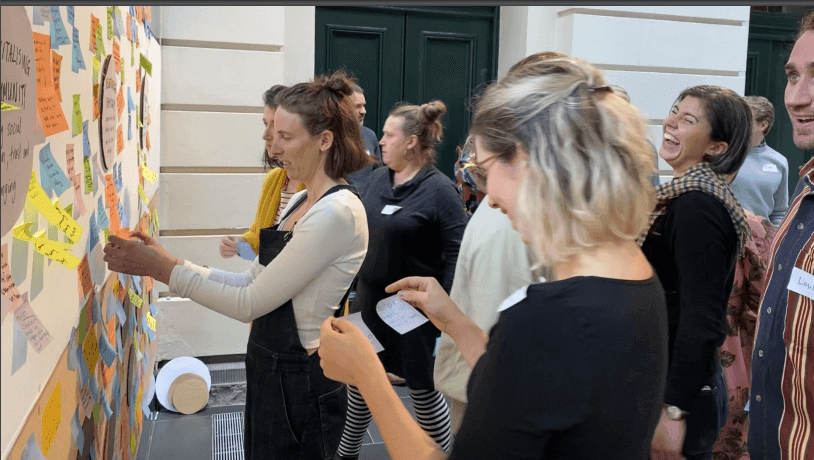
Over the past six months, we have hosted a series of conversations and workshops to build the foundations of this ambitious project. Sharing, listening and designing with 40+ organisations and multiple individuals over this period of time, we have explored what a participatory ecosystem is in service to, and what a thriving democratic life means for Greater Melbourne.

Participatory Melbourne project logic

Phase one of this project was designed as a sense-making, research and insights process — exploring a number of questions:

  • How is active citizenship and participation relevant to a regenerative future?
  • What are the barriers to a thriving democratic life across our economic system?
  • What are the major forces at play, either accelerating or preventing the emergence of a thriving democratic life?
  • What relevant project and research work is currently being undertaken by actors in Melbourne?
  • What are the most potent angles of intervention for the Regen Melbourne alliance to pursue together?

We heard that a thriving democratic life for all is about re-empowering publics to make their own active decisions across all aspects of their lives — including in their communities, their work and how they are governed. 

We heard that active participation is a necessary component for us to heal, to reconnect, to walk side by side and to recreate our systems. And we heard that new forms of leadership are emerging, and need support to thrive, in order to foster the pursuit of a shared future.

None of this is without challenges, over the exploration phase repeated barriers and enablers emerged: forces that constrain and divide us and forces that enable our shared pursuit of a shared future.

Participatory Melbourne, as a collective research and action project, is a response to these systemic gaps and opportunities. 

In order to move through these challenges, it was recognised that we needed ‘creative pathways’ — areas that can focus action through participatory activities across multiple domains of our lives; from how we negotiate with our neighbours through owners corporations, to how we design our businesses, how we value labour and each other as citizens of this place, and of course how we engage with our democratic institutions through our voting in elections and referendums. These were lifted from our deep listening work and are centring our efforts into the future.

Creative Pathways and their associated string of activations

What we believe is needed

Participatory Melbourne recognises that in order to cultivate the conditions for a thriving democratic life we need to recognise and support the many actors working towards this goal — as well as recognising that these diverse actors make up a definable ecosystem.

We believe in order to nourish and strengthen our democratic life we need to strengthen this participatory ecosystem; the interconnected, interlocking projects and activities that work towards collective decision making in urgent times. We also need to make it visible.

For this to work, it isn’t about starting a whole lot of ‘new’ things and forgetting the ‘old’ — we’ve done enough of that in this country. It is also not enough to have a plethora of siloed and segmented activities, each fighting for time and space and voice. We need to move towards a more coherent ecosystem of activity, acting in concert, with both power and precision. Part of our next phase will be to work with you all to bring a map of this ecosystem to life. 

As we surfaced from our deep diving into our insights and observations, we designed a model of activation that helps us place activity in a system of democracy, where each voice can be seen and heard with relation to the other. Through a model of activation and a culture of experimentation, we believe we can take strides towards a thriving democratic life.

With findings, hypotheses and a model in hand, the real work begins in taking our insights and validating with a wider audience — all of you in Greater Melbourne! We’re seeking to bring rigour and evidence to the model via quantitative methods and active validation, leading to the set up for a rollout of potent experiments in 2024.

Importantly alongside all of this, we’ll continue to strengthen the bonds between all the organisations and people working in this space already and paying attention to the emerging forms of leadership alive and well in Greater Melbourne.

So keep an eye on phase two activities surfacing very soon. Until then, click through and have a look at our Phase 1 Executive Summary or Detailed Insights Report below!

We look forward to your participation, in whatever form that may be.

*Written by Regen Melbourne – see original blog here

Natasha Eskinja

Digital Communications Coordinator

Natasha is driven by a profound passion for both creativity and analytics, a synergy that fosters authentic storytelling in the digital realm with both innovation and integrity. 

Throughout her career, she has consistently integrated the overarching marketing and communications narrative with the emotional connections of audiences. She is currently pursuing a Certificate in Society and the Individual from Flinders University, furthering her exploration of human behaviour and the critical importance of connectedness between organisations, individuals, and communities.

LinkedIn | natasha.eskinja@menziesfoundation.org.au

Sarah Jenkins

Strategic Communications Manager

Sarah has more than 18 years’ experience in communications and marketing leadership across a range of sectors.

Communications strategy and organisational growth is a continuing theme in Sarah’s career. Most recently, she leads the development of a Leadership Movement, evaluated by Menzies Viral Co-efficient Model; a contribution to the NFP. 

Sarah’s early career centred around best practice in marketing and communications which later culminated into the establishment of her very own agency. This work extensively spanned across PR, traditional media, event management, strategy, digital marketing, graphic design and business development consultancy. 

In 2019, Sarah joined the lean and robust team at the Menzies Foundation. She has since crafted the Foundation’s narrative and communication strategy. The development of this strategic communications platform is essential for ‘movement building’ and requires a strong strategic, management and communication skills set. Sarah has brought so much to this important work, which sits at the forefront of communication practice. 

Sarah continues to contribute to the NFP sector through her commitment to Purpose; as she reflects on her own leadership, builds her own leadership capability and contributes to the greater good. 

LinkedIn | sarah.jenkins@menziesfoundation.org.au | 0401 880 071

Rohan Martyres

Director, Strategy and Partnerships

Rohan has 15 years’ experience in facilitating cross-sector collaborations to address complex social and health challenges.  He has worked with the World Economic Forum in Australia, led an international conflict resolution field team in Nepal, and directed a 10-year £40m initiative to reduce health inequity in London.

Most recently, Rohan was Major Grants Development Manager at the Ian Potter Foundation.  He refined the foundation’s major grants strategy, and co-developed a series of large scale initiatives, including joint philanthropic-government funding for a new national organization to support place-based approaches across Australia.

Rohan has held several non-executive roles, including with an international NGO and with London Funders, the peak body of independent foundations in London.  He holds several qualifications including a graduate degree in innovation and strategy from the Judge Business School, University of Cambridge.

When Rohan isn’t exploring Melbourne’s creeks with his partner and 6yo daughter, he’s working on his currently weak Australian accent (after 15 years in the UK).

LinkedIn | rohan.martyres@menziesfoundation.org.au | 0404 505 954

Trudy Morrison

Operations Manager

A marketing and communications specialist with over 20 years experience in government, corporate and consumer marketing, Trudy brings her adaptive and organisational project management skills to the Menzies Foundation team. 

With a BA degree in Public Relations, Trudy began her career with the City of Melbourne and in magazine publishing, before moving into marketing communications consulting. She has worked in strategic marketing leadership roles with retail brands and enjoys juggling many projects and tasks simultaneously. Her skills were further enhanced when managing her own communications business representing industries across private education, financial services, aviation, government and the health industry. 

Trudy is passionate about leadership and all people being encouraged to reach their full potential through research and educational initiatives and opportunities throughout Australia. A skilled and accomplished writer and editor Trudy is enthusiastic about bringing her variety of skills to the Menzies Foundation team. 

LinkedIn | trudy.morrison@menziesfoundation.org.au | 0402 361 878

Liz Gillies

Chief Executive Officer

Liz Gillies has had over 25 years experience in a range of fields focused on initiatives for social impact. She has held roles in multiple sectors and academia.

In 2018, Liz was appointed CEO of the Menzies Foundation which aspires to build a leadership movement that supports Australians to pivot to purpose, build their leadership capability and contribute to the ‘greater good’.

Liz joined the Melbourne Business School in 2009 and was instrumental in establishing the Asia Pacific Social Impact Centre (APSIC) and The Centre for Ethical Leadership. In November 2011 she was appointed as research fellow to lead a partnership focused on strategic philanthropy which culminated in the release of the reports: Philanthropy: Towards a Better Practice Model (2018) and the Philanthropy: The Continued Journey to Real Impact and better Practice (2021).

Liz has extensive governance experience, having served on the Board of the Publish Galleries Association of Victoria, Social Firms Australia, Uniting Care Community Options, United Way Australia and the Development Committee of the Towards a Just Society Foundation. She is currently on the Philanthropy Reference Group of Barmal Bijiril and a Director of Philanthropy Australia.

LinkedIn | liz.gillies@menziesfoundation.org.au | 0416 112 703

Natasha Eskinja

Digital Communications Coordinator

Natasha is driven by a profound passion for both creativity and analytics, a synergy that fosters authentic storytelling in the digital realm with both innovation and integrity. 

Throughout her career, she has consistently integrated the overarching marketing and communications narrative with the emotional connections of audiences. She is currently pursuing a Certificate in Society and the Individual from Flinders University, furthering her exploration of human behaviour and the critical importance of connectedness between organisations, individuals, and communities.