

The Courage to Lead Differently

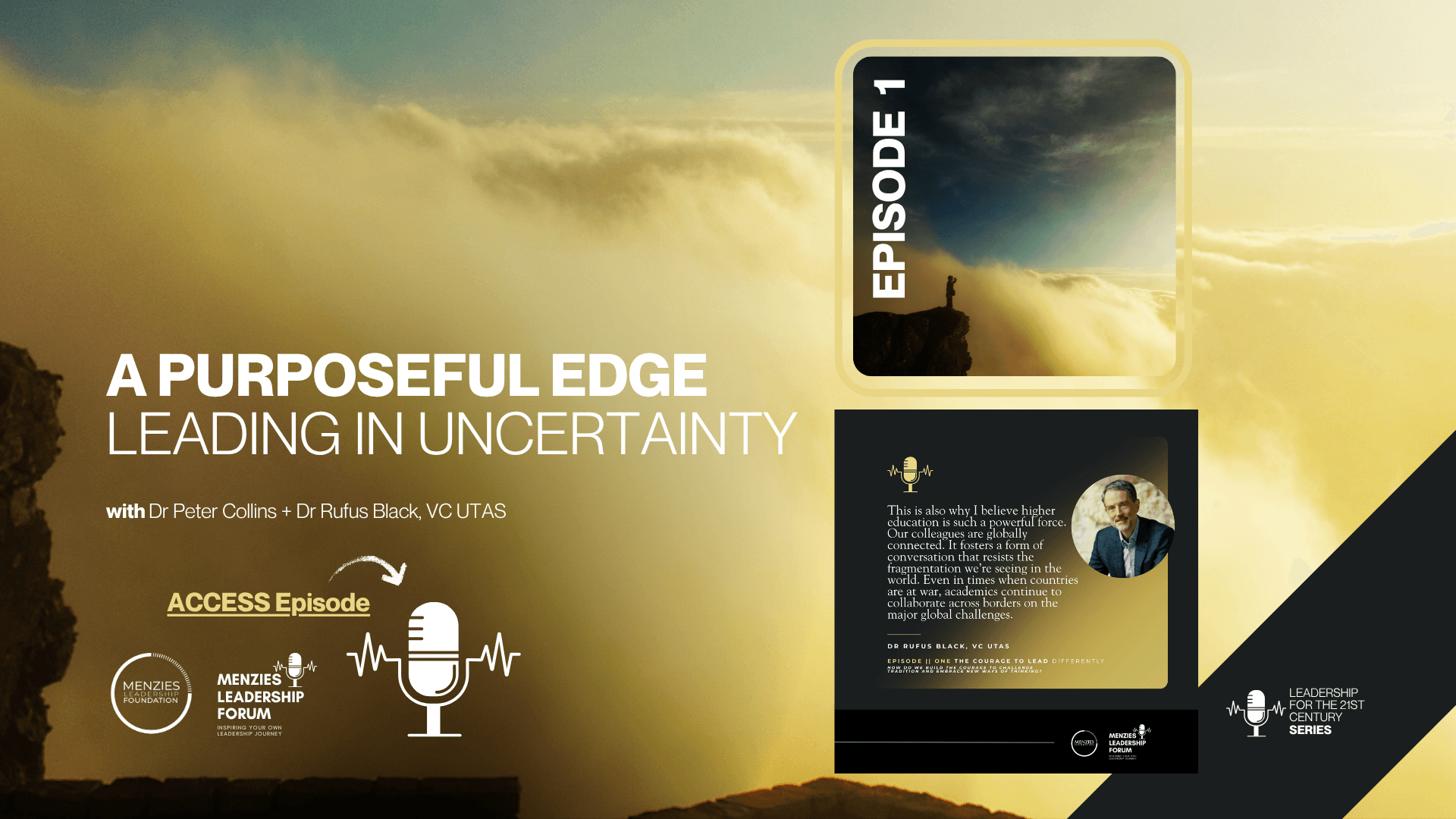
Episode 1, A Purposeful Edge: Leading in Uncertainty

When old certainties collapse, leadership must become something more than operational, it must become deeply transformational.

In this first episode of the A Purposeful Edge: Leading in Uncertainty podcast series, Dr Peter Collins is joined by Professor Rufus Black, Vice Chancellor of the University of Tasmania, to explore how higher education can respond to the defining challenges of our time with purpose, precision and courage. 

Rufus doesn’t shy away from complexity. He names it. 
He describes the end of a post-war era defined by growth and certainty, and the arrival of a new one marked by declining productivity, climate instability, ageing populations, fractured global cooperation and widening inequality. Far from offering a neat solution, Rufus challenges us to sit with the discomfort and lead anyway. 

As the head of a university with global research reach and deep regional roots, Rufus is charting a course few are brave enough to attempt: one that balances urgency with patience, global scale with local impact and adaptive learning with ethical conviction. 

“The greatest danger in the world today is nostalgia. If we keep thinking we can build the future by replicating the past, we are destined for deep danger.”

At UTAS, this philosophy plays out across Antarctic climate research, ecosystem regeneration and sustainable agricultural innovation. In one striking example, the university’s research has enabled dairy farmers to maintain productivity while eliminating harmful nitrogen fertilisers, a shift that’s better for the planet, cheaper for producers and safer for surrounding ecosystems. 

Elsewhere, scientists are working with communities and Traditional Owners to restore Tasmania’s giant kelp forests, vital underwater ecosystems ravaged by climate change and invasive species. The work is laborious and long-term: replanting baby kelp, harvesting sea urchins, rebuilding lobster populations. But for Rufus, this is what leadership looks like: patient, grounded and shared. 

The commitment to equity is equally deliberate. In remote communities like Burnie, UTAS trains nurses, pharmacists and doctors in place, not just to learn, but to stay, contribute and close the opportunity gap. Because for Rufus, place matters. And so does justice. 

“We’ll create a society of outsiders if we don’t reduce inequality. People will feel the system doesn’t serve them and turn away from it.”

This sense of responsibility drives his view that universities cannot stand apart from society. They must act as conveners, collaborators and changemakers, working with governments, industry and citizens to design more sustainable and inclusive futures. And they must do so without defaulting to old models. 

Rufus doesn’t romanticise the sector’s role. He speaks openly about the limitations of higher education and the need for stronger, more strategic community partnerships. But he remains hopeful that universities, if mobilised with clarity and intent, can help lead the adaptive work ahead. 

His own leadership is shaped by lived experience. Diagnosed with dyslexia, he recalls school as a place of exclusion, until a few dedicated educators shifted his trajectory. That early experience now fuels a commitment to make education more expansive, inclusive and just. 

“I know what it’s like to be excluded. That’s why I care so deeply about creating opportunity for others.”

Dr Peter Collins and Rufus Black unpack what it means to lead for the common good, through research, through policy and through partnership, and why values like equity, inclusion and sustainability must be central to any credible leadership model in a time of systemic disruption. 

Listening to Rufus is like watching a slow zoom out: from local paddocks to ocean ecosystems, from regional towns to global systems. The view may be confronting, but it is also coherent. And in Rufus, we find a leader who embraces the complexity, holds the tension and insists on building toward a better future. 

This is not leadership as usual. This is leadership reimagined, adaptive, grounded and fiercely purpose-driven. 

_________________________________________________________________________________ 

🎧 Tune into the full conversation between Dr Peter Collins and Professor Rufus Black to explore what courageous leadership looks like in an era of uncertainty,  and why purpose, partnership and adaptation are the keys to navigating our collective future. 

_________________________________________________________________________________ 

Natasha Eskinja

Digital Communications Coordinator

Natasha is driven by a profound passion for both creativity and analytics, a synergy that fosters authentic storytelling in the digital realm with both innovation and integrity. 

Throughout her career, she has consistently integrated the overarching marketing and communications narrative with the emotional connections of audiences. She is currently pursuing a Certificate in Society and the Individual from Flinders University, furthering her exploration of human behaviour and the critical importance of connectedness between organisations, individuals, and communities.

LinkedIn | natasha.eskinja@menziesfoundation.org.au

Sarah Jenkins

Strategic Communications Manager

Sarah has more than 18 years’ experience in communications and marketing leadership across a range of sectors.

Communications strategy and organisational growth is a continuing theme in Sarah’s career. Most recently, she leads the development of a Leadership Movement, evaluated by Menzies Viral Co-efficient Model; a contribution to the NFP. 

Sarah’s early career centred around best practice in marketing and communications which later culminated into the establishment of her very own agency. This work extensively spanned across PR, traditional media, event management, strategy, digital marketing, graphic design and business development consultancy. 

In 2019, Sarah joined the lean and robust team at the Menzies Foundation. She has since crafted the Foundation’s narrative and communication strategy. The development of this strategic communications platform is essential for ‘movement building’ and requires a strong strategic, management and communication skills set. Sarah has brought so much to this important work, which sits at the forefront of communication practice. 

Sarah continues to contribute to the NFP sector through her commitment to Purpose; as she reflects on her own leadership, builds her own leadership capability and contributes to the greater good. 

LinkedIn | sarah.jenkins@menziesfoundation.org.au | 0401 880 071

Rohan Martyres

Director, Strategy and Partnerships

Rohan has 15 years’ experience in facilitating cross-sector collaborations to address complex social and health challenges.  He has worked with the World Economic Forum in Australia, led an international conflict resolution field team in Nepal, and directed a 10-year £40m initiative to reduce health inequity in London.

Most recently, Rohan was Major Grants Development Manager at the Ian Potter Foundation.  He refined the foundation’s major grants strategy, and co-developed a series of large scale initiatives, including joint philanthropic-government funding for a new national organization to support place-based approaches across Australia.

Rohan has held several non-executive roles, including with an international NGO and with London Funders, the peak body of independent foundations in London.  He holds several qualifications including a graduate degree in innovation and strategy from the Judge Business School, University of Cambridge.

When Rohan isn’t exploring Melbourne’s creeks with his partner and 6yo daughter, he’s working on his currently weak Australian accent (after 15 years in the UK).

LinkedIn | rohan.martyres@menziesfoundation.org.au | 0404 505 954

Trudy Morrison

Operations Manager

A marketing and communications specialist with over 20 years experience in government, corporate and consumer marketing, Trudy brings her adaptive and organisational project management skills to the Menzies Foundation team. 

With a BA degree in Public Relations, Trudy began her career with the City of Melbourne and in magazine publishing, before moving into marketing communications consulting. She has worked in strategic marketing leadership roles with retail brands and enjoys juggling many projects and tasks simultaneously. Her skills were further enhanced when managing her own communications business representing industries across private education, financial services, aviation, government and the health industry. 

Trudy is passionate about leadership and all people being encouraged to reach their full potential through research and educational initiatives and opportunities throughout Australia. A skilled and accomplished writer and editor Trudy is enthusiastic about bringing her variety of skills to the Menzies Foundation team. 

LinkedIn | trudy.morrison@menziesfoundation.org.au | 0402 361 878

Liz Gillies

Chief Executive Officer

Liz Gillies has had over 25 years experience in a range of fields focused on initiatives for social impact. She has held roles in multiple sectors and academia.

In 2018, Liz was appointed CEO of the Menzies Foundation which aspires to build a leadership movement that supports Australians to pivot to purpose, build their leadership capability and contribute to the ‘greater good’.

Liz joined the Melbourne Business School in 2009 and was instrumental in establishing the Asia Pacific Social Impact Centre (APSIC) and The Centre for Ethical Leadership. In November 2011 she was appointed as research fellow to lead a partnership focused on strategic philanthropy which culminated in the release of the reports: Philanthropy: Towards a Better Practice Model (2018) and the Philanthropy: The Continued Journey to Real Impact and better Practice (2021).

Liz has extensive governance experience, having served on the Board of the Publish Galleries Association of Victoria, Social Firms Australia, Uniting Care Community Options, United Way Australia and the Development Committee of the Towards a Just Society Foundation. She is currently on the Philanthropy Reference Group of Barmal Bijiril and a Director of Philanthropy Australia.

LinkedIn | liz.gillies@menziesfoundation.org.au | 0416 112 703

Natasha Eskinja

Digital Communications Coordinator

Natasha is driven by a profound passion for both creativity and analytics, a synergy that fosters authentic storytelling in the digital realm with both innovation and integrity. 

Throughout her career, she has consistently integrated the overarching marketing and communications narrative with the emotional connections of audiences. She is currently pursuing a Certificate in Society and the Individual from Flinders University, furthering her exploration of human behaviour and the critical importance of connectedness between organisations, individuals, and communities.